

Content creation is an incredibly time-consuming endeavor. Crafting a massive, authoritative 3,000-word guide requires days of research, writing, editing, and formatting. The most devastating mistake a digital publisher can make is investing that immense effort into an article that absolutely nobody is searching for. If your content strategy relies purely on intuition rather than empirical data, your blog is destined to become a ghost town.
The foundation of any profitable website is mathematically sound keyword research. You must identify exactly what queries your target audience is typing into search engines, analyze the competitive landscape for those exact phrases, and assess the underlying intent behind the search. This is precisely why relying on a Blog Keyword Generator is the most productive workflow upgrade you can implement. It removes the guesswork and replaces it with actionable, high-volume metrics.
The Mathematics of Long-Tail Keywords
When novice bloggers attempt keyword research, they inevitably target "Short-Tail" keywords—broad, one or two-word phrases like "Fitness" or "Digital Marketing." This is a mathematical impossibility for a new website. Short-tail keywords have astronomical search volumes, but they are completely dominated by mega-corporations with multi-million dollar SEO budgets. Attempting to rank for "Shoes" is a waste of time.
The true money lies in the "Long-Tail." These are hyper-specific phrases containing four or more words, such as "Best waterproof trail running shoes for wide feet." While the search volume is significantly lower, the competition is non-existent, and the conversion intent is absolute. A user searching for that specific phrase has their credit card in hand. By targeting hundreds of these low-competition, high-intent phrases, your cumulative traffic will quickly eclipse what you would receive even if you somehow ranked on page two for a broad term.
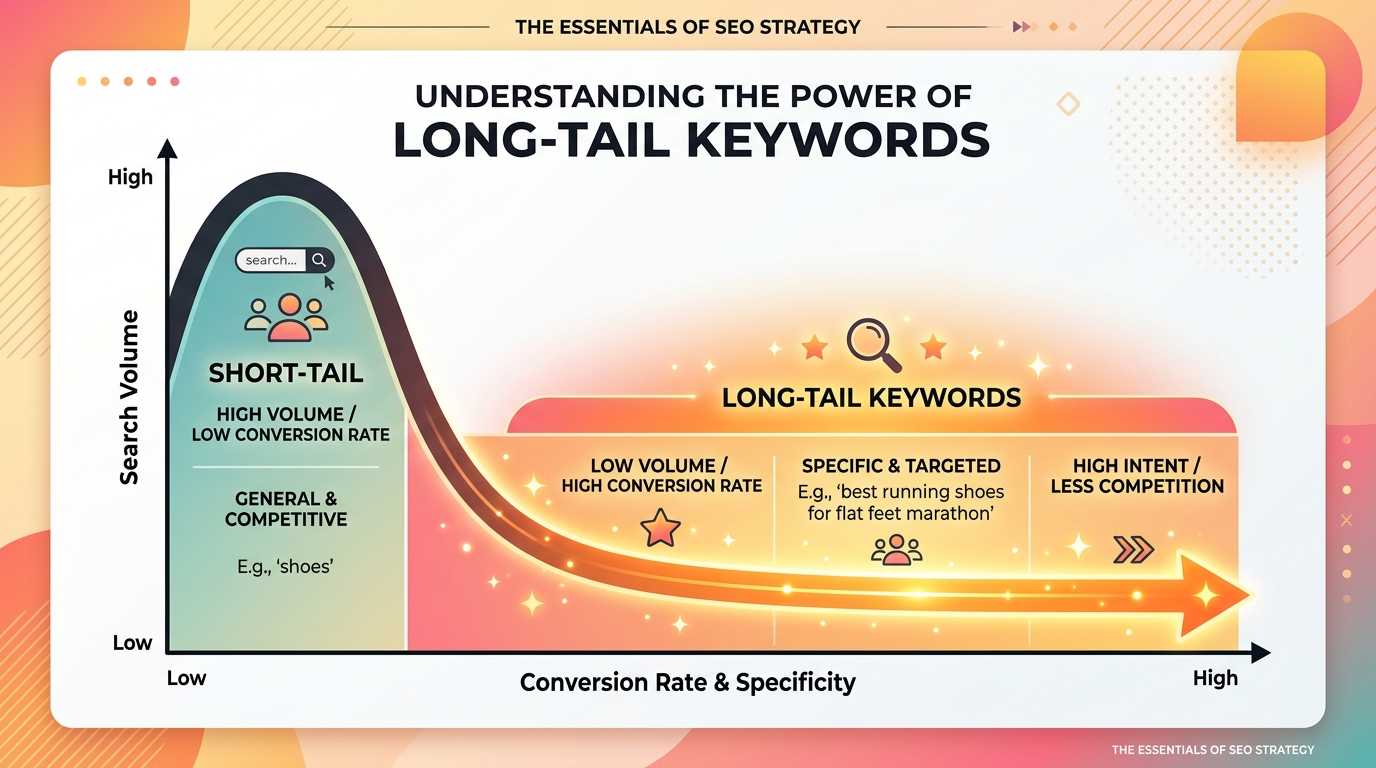
The Long-Tail curve: While broad terms have high volume, the specific long-tail queries drive exponentially higher conversion rates.
Case Study: Niche Affiliate Domination
Consider a mid-sized tech blog struggling to monetize their content. They spent six months trying to rank for "Best Laptops 2026" and failed to break into the top 50 results. Their traffic was stagnant, and their affiliate revenue was zero.
They pivoted their strategy and ran their seed topics through a keyword generator. Instead of broad terms, they uncovered highly specific informational queries like "How to fix overheating on Lenovo Legion 5" and "Best budget laptop for studying computer science in Nepal." They wrote highly detailed, 1,500-word answers to these exact questions. Within two months, they captured the #1 snippet for over 40 long-tail variations. Their traffic skyrocketed by 600%, and because the users had high transactional intent, their affiliate revenue followed suit.
Expert Tips for Content Strategy
- Analyze Search Intent: Does the user want to buy something (Transactional), learn something (Informational), or find a specific website (Navigational)? Ensure your article format matches their exact intent.
- Look at the "People Also Ask" Box: Google explicitly tells you what related questions users have. Use your keyword tool to extract these and turn them into H2 headers in your article.
- Don't Keyword Stuff: Write for humans first. If you force a keyword into a sentence unnaturally, Google's NLP (Natural Language Processing) algorithms will detect it and penalize the page.
- Monitor Your Rankings: Use a Technical SEO Analyzer to ensure your generated keywords are perfectly placed in your Meta Title and H1 tags.
Strategic Insight: If you want to dive deeper into the economics of the long tail, we highly recommend reading Ahrefs' comprehensive Guide to Long-Tail Keywords to understand the math behind low-volume, high-yield traffic.
Frequently Asked Questions (FAQ)
1. What is a good monthly search volume to target?
For a new blog, targeting keywords with 50 to 250 monthly searches is ideal. While this sounds low, ranking #1 for ten of these terms will generate a highly consistent, converting stream of 1,000+ targeted visitors per month.
2. What does Keyword Difficulty (KD) mean?
Keyword Difficulty is a metric (usually 0-100) estimating how hard it will be to rank on the first page of Google. It is heavily based on the backlink profiles of the current top-ranking pages. Beginners should strictly target keywords with a KD under 20.
3. How many times should I use my main keyword?
There is no magic density percentage. Place your main keyword naturally in the URL, the Meta Title, the H1, and within the first 100 words of the introduction. Beyond that, simply write naturally and use semantic variations.
4. Can I target multiple keywords on a single page?
Yes, and you should. By writing comprehensive, long-form content, a single article will naturally rank for dozens, sometimes hundreds, of secondary long-tail variations of your primary topic without any extra effort.