

If there is one universal truth about high school and university life, it is the constant battle against word limits. Every syllabus, every assignment brief, and every final exam rubric comes with a terrifyingly specific constraint: "Write an essay of no less than 1,500 words and no more than 2,000 words."
For many students, hitting that sweet spot feels like trying to land an airplane on a postage stamp. You pour your heart and soul into researching a topic, draft a brilliant argument, and suddenly realize you are 800 words over the limit. Panic sets in. You start randomly deleting sentences, removing adjectives, and breaking the natural flow of your narrative just to appease a strict professor.
This chaotic editing process is the exact reason why academic essays often end up sounding choppy and incoherent. In this comprehensive guide, we are going to explore the psychology behind academic word limits, why brevity is the ultimate sign of intellectual mastery, and how using a dedicated online word counter can transform your chaotic rough drafts into perfectly polished, high-scoring essays.
Why Do Professors Enforce Strict Word Limits?
When you are staring at a document that is 500 words over the limit, it is easy to assume that professors invent word counts just to torture their students. However, academic constraints serve two highly specific pedagogical purposes.
1. Forcing Analytical Prioritization
French mathematician Blaise Pascal famously wrote, "I have made this letter longer than usual because I lack the time to make it shorter." Writing a 10,000-word brain dump on the causes of World War II is surprisingly easy. Synthesizing those massive historical causes into a tight, compelling 1,500-word argument is incredibly difficult.
Word limits force you to evaluate your own ideas critically. You must look at your three supporting arguments and decide which one is the absolute strongest. By forcing you to cut the weaker points, constraints guarantee that only your most rigorous, high-quality analysis remains on the page.
2. Standardization and Grading Equity
From a logistical standpoint, university professors often have to grade hundreds of essays over a single weekend. If one student submits a 3-page summary and another submits a 15-page dissertation, it is impossible to grade them on the same equitable rubric. Furthermore, exceeding a word limit is often penalized simply because it demonstrates an inability to follow basic professional instructions—a skill required in any future career.
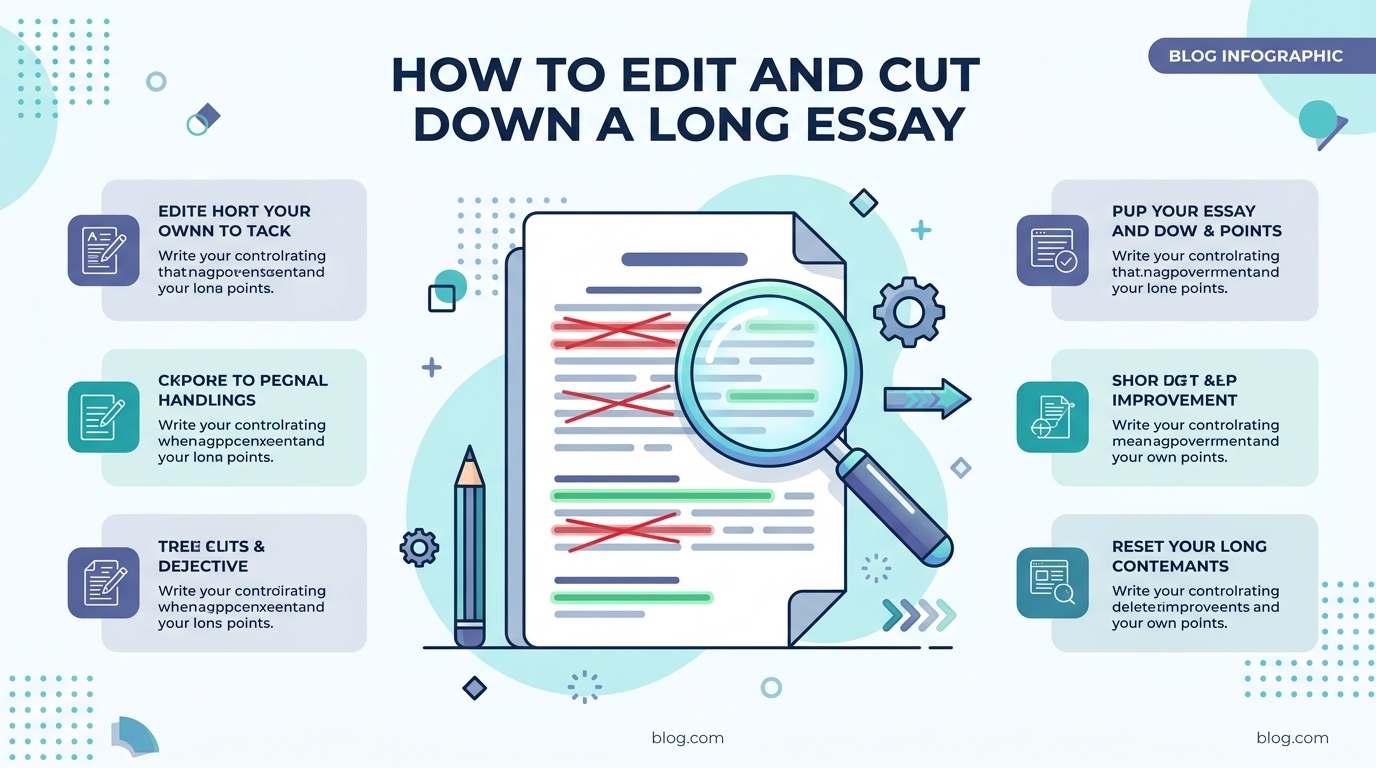
Editing is a subtractive art. Highlighting unnecessary adjectives and crossing out redundant phrases is the fastest way to hit your target word count without losing your core argument.
The Four-Step Framework for Cutting Words
So, you've pasted your essay into a Word Counter Tool and the massive red number stares back at you: you are 400 words over the limit. How do you trim the fat without destroying your grade? Follow this systematic four-step framework:
Step 1: Eliminate Meta-Discourse
Meta-discourse is when you write about what you are going to write about. Phrases like "In this essay, I will attempt to demonstrate that..." or "It is important to note that..." add absolutely zero value to your argument. They are verbal fluff. Strip them out completely. State your argument directly.
Step 2: Hunt Down "Zombie Nouns" (Nominalizations)
Academic writing is notoriously plagued by nominalizations—taking perfectly good, active verbs and turning them into clunky, multi-word nouns. For example, instead of writing "They decided," students will write "They reached a decision." Instead of "The government analyzed the data," they write "The government conducted an analysis of the data."
Reverting zombie nouns back into active verbs instantly tightens your sentence structure and naturally slashes your overall word count.
Step 3: Remove Redundant Modifiers
Amateur writers often use adjectives and adverbs to prop up weak nouns and verbs. Phrases like "absolutely essential," "future plans," or "past history" are completely redundant. If something is essential, it is already absolute. History is, by definition, in the past. Delete the modifiers and trust the power of your core nouns.
Productivity Tip: Editing your own work immediately after drafting it is incredibly difficult because your brain is still attached to the words you just wrote. Let your draft sit overnight. If you struggle with focus during the editing phase, try utilizing a Pomodoro Timer to force 25 minutes of highly aggressive, emotionally detached text cutting.
Why Not Just Use Microsoft Word's Built-In Counter?
A common question among students is why they should bother using a dedicated online word counter when their word processor already has one built into the bottom status bar.
The answer lies in advanced metrics. A high-quality online tool does much more than simply count spaces between letters. It analyzes reading level, calculates keyword density (to ensure you haven't repeated the same transitional phrase 40 times), and provides character counts with and without spaces—a metric critically important for students submitting applications via strict online web forms.
Furthermore, online text analysis tools often provide a clean, distraction-free interface. When you paste your text into a minimalist web tool, you strip away the formatting, the red squiggly spellcheck lines, and the bulky UI toolbars. You are left staring purely at the raw architecture of your words, which often makes structural editing significantly easier.
Frequently Asked Questions (FAQ)
1. Is there a safe margin of error for university word limits?
Most academic institutions operate on a strict +/- 10% rule. For a 2,000-word essay, anything between 1,800 and 2,200 words is generally acceptable without penalty. However, you should always explicitly confirm this rule with your specific professor, as some automated submission portals (like Turnitin or Canvas) will hard-reject submissions that are even one word over the hard limit.
2. Do citations and bibliographies count toward the word limit?
In standard academic formats (APA, MLA, Chicago), the Reference List or Bibliography at the end of the document is almost never included in the final word count. However, in-text citations (e.g., Smith, 2024, p. 12) usually are counted by default word processors. If your essay is heavily cited, this can artificially inflate your count by hundreds of words.
3. How can I increase my word count without adding "fluff"?
If you are significantly under the limit, do not increase the font size of your periods or add unnecessary adjectives—professors can spot this instantly. Instead, expand on your analysis. Provide a concrete, real-world example to illustrate an abstract point, or address a potential counter-argument to your thesis and dismantle it. Adding depth is always better than adding width.
Conclusion
Word limits are not punishments; they are parameters designed to forge you into a more concise, impactful communicator. The ability to look at a sprawling, chaotic draft and surgically carve away the excess until only the strongest arguments remain is a skill that pays dividends long after you graduate university.
Stop letting constraints dictate your anxiety. By utilizing a robust Word Counter alongside aggressive, active-voice editing strategies, you can turn the revision process into a satisfying puzzle. Trim the fat, clarify your thesis, and submit your next academic paper with total confidence.