

Imagine sitting down at your desk with a massive textbook, a looming final exam, and a cup of coffee. You tell yourself, "I am going to study for the next five hours straight without moving." Three hours later, you realize you have been mindlessly scrolling through social media, you haven't retained a single paragraph of information, and you feel entirely exhausted.
If this scenario sounds familiar, you are not alone. The human brain was simply not designed for prolonged, unbroken periods of intense concentration. Academic burnout is a massive epidemic among high school and university students, driven largely by the toxic misconception that longer study sessions equal better grades.
The truth is entirely the opposite. The most successful students don't study longer—they study smarter. They leverage the neurobiology of attention spans. In this article, we are going to dive deep into a time management framework that has revolutionized academic preparation globally: The Pomodoro Technique. We will explore how it hacks your brain's reward centers, prevents cognitive fatigue, and how using a dedicated online Pomodoro timer can instantly double your learning retention.
What is the Pomodoro Technique?
The Pomodoro Technique was invented in the late 1980s by Francesco Cirillo, a university student who was struggling to focus on his studies. Desperate to pass his exams, he grabbed a kitchen timer shaped like a tomato (pomodoro in Italian), set it for 25 minutes, and committed to focusing exclusively on his textbook until the bell rang.
He discovered something incredible: when faced with a massive, terrifying task (like writing a 5,000-word essay), his brain would procrastinate to avoid the stress. But when he broke that massive task into a tiny, manageable 25-minute window, the psychological resistance vanished.
The core framework of the technique is beautifully simple:
- Step 1: Pick a single, specific task to work on.
- Step 2: Set a timer for 25 minutes (one "Pomodoro").
- Step 3: Work intensely and exclusively on that task. Zero distractions allowed.
- Step 4: When the timer rings, take a strict 5-minute break.
- Step 5: After completing four Pomodoros (two hours total), take a longer 15 to 30-minute restorative break.
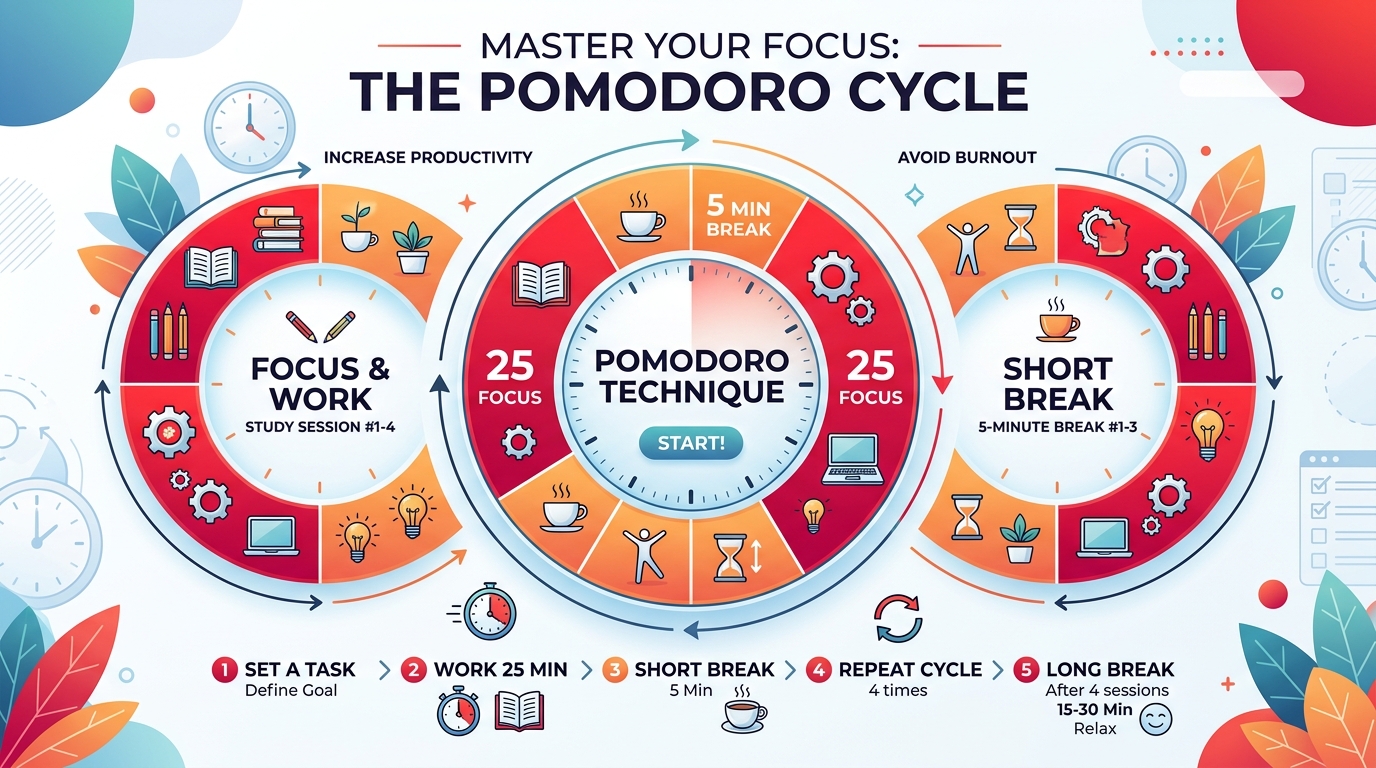
The repeating cycle of intense focus followed by mandatory rest prevents the steady decline in cognitive performance known as "decision fatigue."
The Neuroscience of Rest and Retention
Why is that 5-minute break so critical? To understand its power, we must look at how the brain consolidates memories.
Your brain operates in two distinct modes: the focused mode and the diffuse mode. When you are reading a textbook, calculating a math equation, or using a typing tutor, your brain is in the focused mode. It is actively acquiring new data and burning high amounts of glucose to maintain concentration.
However, the brain does not actually wire those new concepts into long-term memory while you are focusing. Memory consolidation happens when the brain slips into the diffuse mode—a state of relaxed, wandering thought. This is why you often get your best ideas in the shower, or figure out the answer to a tricky exam question right as you fall asleep.
By forcing you to take a 5-minute break every half hour, the Pomodoro Technique systematically triggers the diffuse mode. During those five minutes, your hippocampus is quietly transferring the concepts you just studied into long-term storage, freeing up working memory for the next 25-minute block. If you skip the breaks and study for three hours straight, your working memory becomes completely saturated, and any new information you read simply bounces off.
Defeating the Procrastination Monster
Procrastination is rarely a time-management problem; it is an emotion-regulation problem. When a student is assigned a 20-page research paper, their brain interprets the sheer size of the task as a threat, triggering a mild pain response. To escape the pain, the student opens TikTok or starts organizing their desk.
The Pomodoro Technique tricks the brain's threat-detection system. Instead of focusing on the massive end goal (finishing the essay), the student only focuses on the process (working for 25 minutes). Anyone, no matter how tired or unmotivated, can convince themselves to work for just 25 minutes.
Once the timer starts ticking, a psychological phenomenon known as the Zeigarnik Effect kicks in. This effect dictates that human beings naturally hate leaving tasks uncompleted. Once you have started the 25-minute timer, your brain actually wants to keep working until the bell rings.
Pro Tip: Do not spend your 5-minute breaks looking at a screen. The goal is cognitive rest. Stand up, stretch, look out a window, or drink a glass of water. Looking at social media during a break will trap your brain in an anxiety-inducing dopamine loop, completely destroying your next 25-minute focus session.
Why You Need a Dedicated Timer App
You might be wondering, "Why can't I just use the clock app on my smartphone?"
The answer is simple: your smartphone is a hyper-engineered distraction machine. If you pick up your phone to set a 25-minute alarm, you are guaranteed to see a barrage of push notifications. A single text message from a friend will derail your entire study session before it even begins.
This is why top-tier students utilize browser-based utilities like our completely free Online Pomodoro Timer. By running the timer in a pinned tab on your laptop, you can physically lock your smartphone in another room. Our timer handles the 25/5 intervals automatically, tracks your completed rounds, and plays a gentle audio chime when it is time to rest, ensuring you never have to break your visual focus to check the clock.
Frequently Asked Questions (FAQ)
1. Do I have to strictly use 25-minute intervals?
No, the 25-minute interval is a guideline, not a strict rule. Some students find that for deep creative work (like writing or coding), 25 minutes isn't enough time to get into the flow state. Many university students prefer a 50-minute focus block followed by a 10-minute break. Experiment with different lengths to find your personal cognitive sweet spot.
2. What if I finish my task before the timer rings?
If you finish a task (like reading a chapter) with 5 minutes left on the clock, do not stop! Use the remaining time to review what you just read, highlight key concepts, or immediately begin outlining the next task. The rule of the Pomodoro is that the timer dictates the work, not the completion of the task.
3. How many Pomodoros should I aim for in a day?
A standard workday consists of 12 to 14 Pomodoros. However, for intense academic study, hitting 8 perfect, distraction-free Pomodoros (about 4 hours of pure focus) is considered a massively successful day. Trying to force 16 Pomodoros in a single day right before an exam is a guaranteed recipe for burnout.
Conclusion
In an era of endless digital distractions, the ability to sit down and focus intensely on a single academic task is akin to a superpower. The students who master this skill do not necessarily have higher IQs; they simply have better systems.
Stop letting procrastination and cognitive fatigue dictate your academic performance. Open up a Pomodoro Timer, commit to just 25 minutes of unbroken work, and watch as your productivity skyrockets while your stress levels plummet. It is the ultimate study hack, and it is entirely free to start using today.