Regional Kashmir Font Converter — 100% Secure & Private.
Sharada Legacy Legacy
Unicode
Source Input
Live Output
What is Sharada Legacy Font?
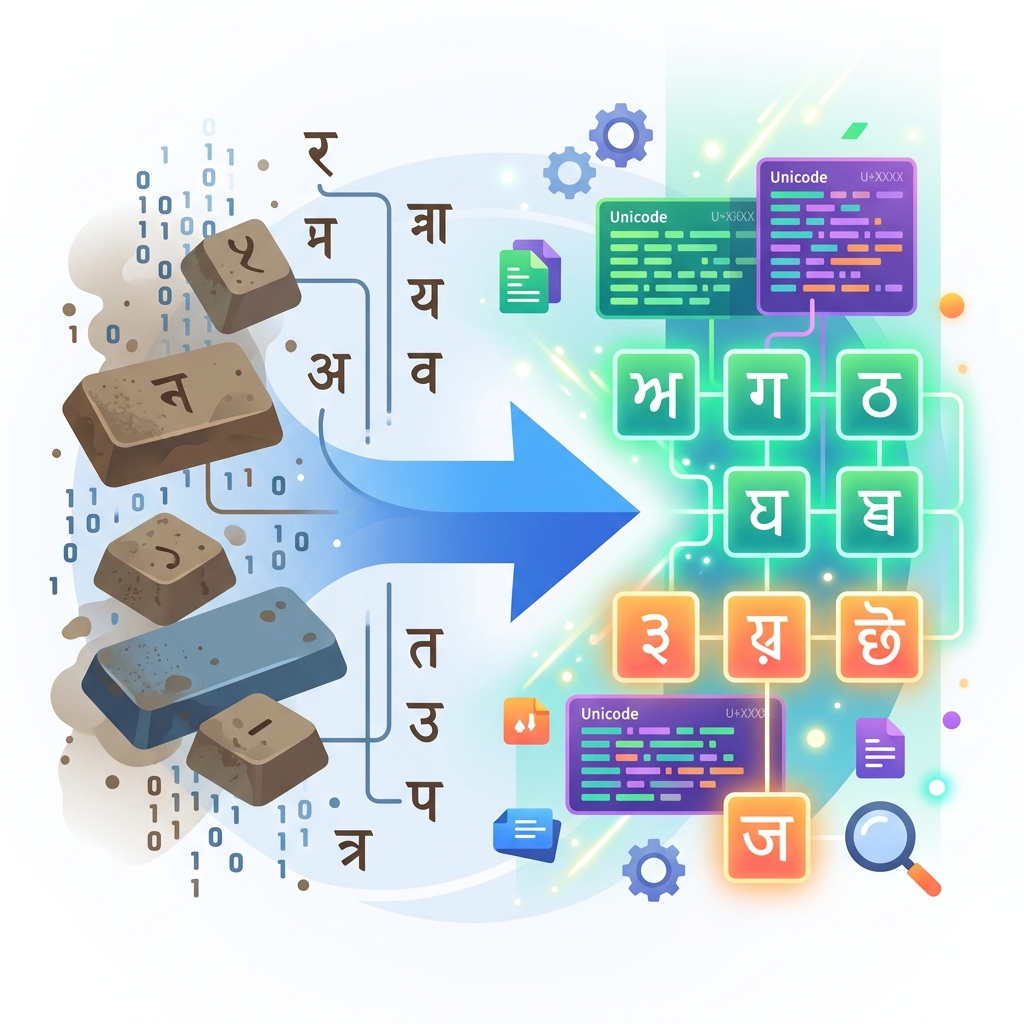
Sharada Legacy is a legacy encoding used for Kashmir regional script typing. Because it maps characters to standard keyboard keys rather than Unicode positions, this tool is required to convert Sharada Legacy text into modern Unicode for web display and digital publishing.
Privacy & Offline Support
Our Sharada Legacy font converter runs entirely in your browser. None of the text you type or convert is sent to any server. This makes it perfect for private document processing and ensures zero data leaks.
Quick Guide
1
Paste your Sharada Legacy text into the source input area.
2
The tool will instantly convert it to standard Unicode below.
3
Click 'Copy Result' to use the Unicode text anywhere online.
4
Use the Vicerversa (Swap) button to convert from Unicode back to Sharada Legacy.
Technical Specs
Encoding Engine
Our high-performance engine uses a two-pass mapping system to resolve character swaps and script-specific vowel reordering rules, ensuring that your text remains linguistically accurate after conversion.
Unicode is the industry standard for consistent encoding, representation, and handling of text across most of the world's writing systems. Legacy fonts like Sharada Legacy were designed before Unicode adoption.
Verified by Expert Editorial Team
Sharada Legacy to Unicode Converter
Seamlessly convert ancient Kashmiri Sharada script typed in legacy fonts to universally standardized Sharada Unicode blocks. Optimize archiving, academic publishing, and historical research.
The Sharada Legacy to Unicode Converter is a highly specialized digital tool built to bridge the gap between archaic desktop publishing techniques and the modern era of standardized computing. For academics, linguistic researchers, and historians working extensively with ancient Kashmiri and Sanskrit manuscripts, this conversion tool offers an unparalleled lifeline. By transforming invisible, broken keyboard encodings into pure Sharada Unicode data, it unlocks centuries of previously inaccessible historical texts for global digital research, search engine indexing, and seamless preservation.
The Significance of the Sharada Script
The Sharada script is a crucial writing system historically used in the Indian subcontinent, specifically in Kashmir and neighboring regions, for writing Sanskrit and Kashmiri. Originating around the 8th century CE, it belongs to the Brahmic family of scripts. Its historical importance lies in the vast corpus of mathematical, philosophical, and literary texts preserved through it.
As digital typography emerged, historians and scholars sought to digitize these invaluable manuscripts. Before Unicode standardization, they created bespoke, non-standard legacy fonts. These "Sharada Legacy" fonts mapped visually complex Sharada characters onto standard English (ASCII) keyboard layouts, allowing localized typing but breaking fundamental digital compatibility.
The Problem with Legacy Font Encoding
Legacy fonts function purely as a visual "mask" over standard characters. If you type the English letter 'k' while using a legacy Sharada font, the screen displays a Sharada glyph, but the underlying data remains the letter 'k'. If a colleague opens this document without that specific proprietary font installed, the text immediately reverts to incomprehensible English gibberish.
This legacy trap severely hinders academic archiving. Texts locked in legacy formats cannot be reliably searched, parsed by modern natural language processing (NLP) algorithms, or indexed by search engines. They remain digitally isolated, completely invisible to the modern internet ecosystem.
How Our Conversion Engine Works
Our Sharada Legacy to Unicode Converter resolves this data isolation by permanently translating the underlying binary data into proper Unicode. Unicode provides a universal, standardized mathematical ID for every character. The Sharada script was officially incorporated into the Unicode Standard (block U+11180–U+111DF).
When you input text encoded in a legacy font, our engine analyzes the raw keystroke data. Utilizing complex, script-specific transliteration algorithms, it mathematically maps the ASCII/legacy input to the pristine Sharada Supplementary Multilingual Plane (SMP) block. The output is pure, uncorrupted Unicode text that renders correctly across all modern browsers, smartphones, and operating systems.
Sharada Keyboard Character Mapping
The table below provides a simplified demonstration of how common legacy keystrokes are mathematically mapped to their official Sharada Unicode equivalents.
Legacy Keystroke
Equivalent Devanagari Base
Sharada Unicode Output
Unicode Hex
v
अ
𑆃
U+11183
d
क
𑆑
U+11191
[
ख
𑆒
U+11192
x
ग
𑆓
U+11193
Official Government & Institutional Use
In Bangladesh, the Bijoy system was deeply integrated into official government workflows, the National Curriculum and Textbook Board (NCTB), and the Election Commission for decades. Because it was the first highly accessible and robust Bengali typing solution, nearly all state circulars, legal documents, and textbooks printed before the widespread adoption of Unicode were typed using SutonnyMJ. Understanding and converting this format is absolutely essential for historians, researchers, and government officials seeking to access, digitize, or modernize historical state records.
Modern Database Preservation
For research institutions, museums, and historical archives, upgrading legacy text to Unicode is a non-negotiable step for long-term preservation. Web crawlers and search algorithms cannot index legacy-encoded texts. Valuable historical journals published in legacy fonts remain undiscoverable to Google, Bing, and AI research tools.
By standardizing your archives with our tool, your texts instantly become globally accessible and searchable. This facilitates cross-referencing and discovery by historians worldwide. If you manage extensive archives spanning multiple regional scripts, consider using our Modi Script Converter and our Grantha Legacy Converter to ensure your entire historical database is Unicode-compliant.
Frequently Asked Questions
Expert Insights & FAQs
Quick answers to common questions about this utility.
4 Frequently Asked Questions
Is it secure to process unpublished historical manuscripts on this site?
Yes. Our Sharada Legacy converter processes everything client-side within your browser. Your sensitive or unpublished manuscript data is never transmitted to our servers, ensuring absolute privacy.
Why might the converted Sharada Unicode text render incorrectly?
Unlike legacy fonts which force visual shapes, Unicode relies on your system's rendering engine and installed fonts. If the converted text appears as boxes or renders incorrectly, ensure you have a standard Sharada Unicode font (such as 'Noto Sans Sharada') installed on your operating system.
Can I convert Unicode text back into the Sharada Legacy format?
Yes, the tool is bidirectional. You can paste standard Sharada Unicode text and convert it back to legacy encoding, which is helpful if you need to use older publishing software that hasn't been updated to support complex Unicode shaping.
Is this converter compatible with mobile devices and tablets?
Absolutely. Because it operates through standard web technologies, you can convert text on Windows, macOS, iOS, or Android devices. The resulting pure Unicode text can be seamlessly pasted into any modern application.