Regional S. India Font Converter — 100% Secure & Private.
Grantha Legacy Legacy
Unicode
Source Input
Live Output
What is Grantha Legacy Font?
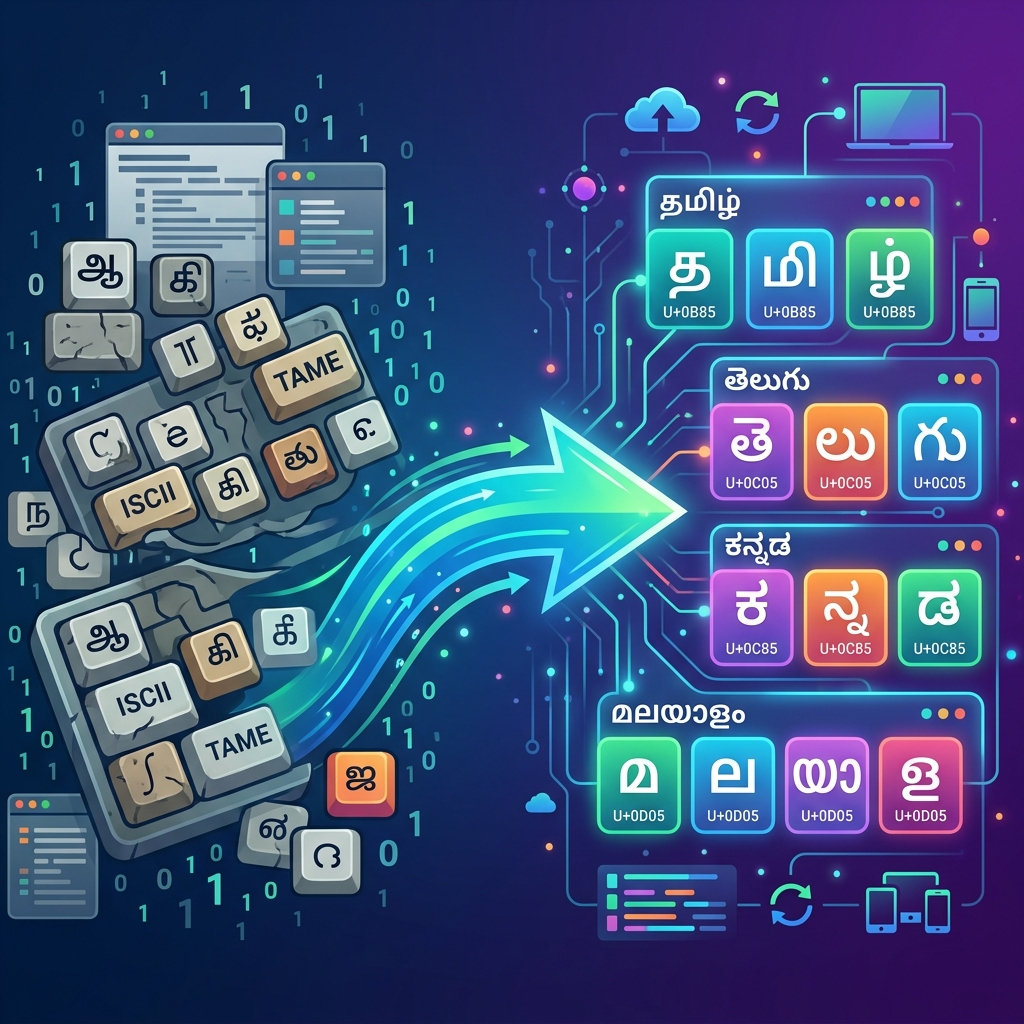
Grantha Legacy is a legacy encoding used for S. India regional script typing. Because it maps characters to standard keyboard keys rather than Unicode positions, this tool is required to convert Grantha Legacy text into modern Unicode for web display and digital publishing.
Privacy & Offline Support
Our Grantha Legacy font converter runs entirely in your browser. None of the text you type or convert is sent to any server. This makes it perfect for private document processing and ensures zero data leaks.
Quick Guide
1
Paste your Grantha Legacy text into the source input area.
2
The tool will instantly convert it to standard Unicode below.
3
Click 'Copy Result' to use the Unicode text anywhere online.
4
Use the Vicerversa (Swap) button to convert from Unicode back to Grantha Legacy.
Technical Specs
Encoding Engine
Our high-performance engine uses a two-pass mapping system to resolve character swaps and script-specific vowel reordering rules, ensuring that your text remains linguistically accurate after conversion.
Unicode is the industry standard for consistent encoding, representation, and handling of text across most of the world's writing systems. Legacy fonts like Grantha Legacy were designed before Unicode adoption.
Verified by Expert Editorial Team
Grantha Legacy to Unicode Converter
Seamlessly convert ancient Grantha script typed in legacy fonts to universally standardized Grantha Unicode blocks. Optimize archiving, academic publishing, and data processing.
The Grantha Legacy to Unicode Converter is a highly specialized digital tool built to bridge the gap between archaic desktop publishing techniques and the modern era of standardized computing. For academics, linguistic researchers, and historians working extensively with ancient South Indian manuscripts, this conversion tool offers an unparalleled lifeline. By transforming invisible, broken keyboard encodings into pure Grantha Unicode data, it unlocks decades of previously inaccessible historical texts for global digital research, search engine indexing, and seamless preservation.
The Significance of the Grantha Script
The Grantha script is one of the most historically important writing systems in South India and Southeast Asia. Used primarily between the 6th and 20th centuries, Grantha was the definitive script for writing classical Sanskrit across the Tamil-speaking regions. Because Tamil itself lacks the extensive phonetic inventory required to perfectly transcribe complex Sanskrit phonemes (like aspirated consonants), Grantha was invented to accurately represent sacred texts, scholarly treatises, and royal inscriptions.
As digital desktop publishing expanded in the late 1990s and early 2000s, scholars eager to digitize Grantha manuscripts were forced to create their own "hacky" font solutions, often piggybacking on the visual architecture of Malayalam or Tamil legacy fonts. These early encoding systems are now what we refer to as "Grantha Legacy."
The Problem with Legacy Font Encoding
Legacy fonts are effectively visual illusions. In a legacy Grantha font, pressing the English key 'k' on a QWERTY keyboard might draw a Grantha character on the screen, but the computer fundamentally believes it is merely saving the English letter 'k'. If you take a document typed in a legacy Grantha font and open it on a modern smartphone, iPad, or any computer that does not have that exact, proprietary font file installed, the document instantly shatters into a meaningless string of English gibberish.
This is a catastrophic problem for digital archiving. If the text is fundamentally just English letters wearing a Grantha "mask," search engines like Google cannot read the text, academics cannot copy and paste it into modern web platforms, and automated linguistic analysis algorithms fail completely.
How Our Conversion Engine Works
Our Grantha Legacy to Unicode Converter completely eliminates this problem by fundamentally altering the underlying binary data. Unicode is the global standard for text encoding, assigning a unique, permanent mathematical ID to every character in almost every human language. The Grantha script was officially added to the Unicode standard in version 7.0 (allocated to the U+11300–U+1137F block).
When you paste your broken legacy text into our converter, the JavaScript engine bypasses the visual font layer and directly parses the raw keystrokes. It utilizes a highly complex, mathematical mapping algorithm based on the ISCII (Indian Script Code for Information Interchange) structure. By cross-referencing the legacy keystrokes with Kruti-based and Malayalam-based layouts, it mathematically shifts the output directly into the pristine Grantha Supplementary Multilingual Plane (SMP) block. The result is pure, uncorrupted Unicode text that will display perfectly on any modern operating system forever.
Grantha Keyboard Character Mapping
Below is a simplified breakdown of how common legacy keystrokes are mathematically transposed into their correct Grantha Unicode counterparts. This illustrates the underlying complexity of standardizing regional legacy fonts.
English Keystroke (Legacy)
Equivalent Devanagari Base
Grantha Unicode Output
Unicode Hex
v
अ
𑌅
U+11305
d
क
𑌕
U+11315
[
ख
𑌖
U+11316
x
ग
𑌗
U+11317
Modern Database Preservation
For research universities and digital libraries, converting Grantha legacy text is not optional—it is mandatory for digital survival. Modern web algorithms and indexing systems absolutely cannot index text wrapped in legacy encodings. If you publish a historical journal using legacy fonts, that text is invisible to Google, Bing, and AI language models.
By migrating your archives to Unicode using our tool, your texts instantly become searchable on a global scale. This allows historians and linguists across the world to easily discover, cite, and cross-reference your digitized materials. Furthermore, if you handle multiple South Indian script archives, we highly recommend utilizing our Malayalam Revathi Converter and our Tamil Bamini Converter to ensure your entire regional database is globally compliant.
Frequently Asked Questions
Expert Insights & FAQs
Quick answers to common questions about this utility.
4 Frequently Asked Questions
Is it completely safe to convert ancient Grantha manuscripts on this site?
Yes, absolutely. Our Grantha Legacy converter utilizes a client-side JavaScript architecture. This means the complex mathematical conversion process happens directly inside your web browser. Your rare or unpublished manuscript data is never uploaded to an external server, guaranteeing total privacy and academic security.
Why does Grantha Unicode look slightly different from my legacy font?
Legacy fonts were often built as "hacks," ignoring strict typographic rules to force characters to look a specific way. Unicode, however, relies on your operating system's rendering engine to display complex conjuncts accurately based on linguistic rules. If the text looks slightly off, ensure you have a modern, officially supported Grantha Unicode font (like 'Noto Sans Grantha') installed on your device.
Can this tool convert Grantha back into legacy format?
Yes. This tool is fully bidirectional. By toggling the switch, you can take pristine Grantha Unicode text and downgrade it mathematically back into legacy encoding. This is particularly useful for printing presses that still rely on outdated PageMaker software that cannot handle complex Unicode shaping.
Does this tool work natively on Mac and iOS?
Yes. The conversion engine works flawlessly on Windows, macOS, iOS, and Android. Because it outputs pure Unicode, the resulting text can be copied and pasted directly into WhatsApp, Facebook, MS Word, and WordPress without requiring any font installations.