Regional Japan Font Converter — 100% Secure & Private.
Shift-JIS Legacy
Unicode
Source Input
Live Output
What is Shift-JIS Font?
Shift-JIS is a legacy encoding used for Japan regional script typing. Because it maps characters to standard keyboard keys rather than Unicode positions, this tool is required to convert Shift-JIS text into modern Unicode for web display and digital publishing.
Privacy & Offline Support
Our Shift-JIS font converter runs entirely in your browser. None of the text you type or convert is sent to any server. This makes it perfect for private document processing and ensures zero data leaks.
Quick Guide
1
Paste your Shift-JIS text into the source input area.
2
The tool will instantly convert it to standard Unicode below.
3
Click 'Copy Result' to use the Unicode text anywhere online.
4
Use the Vicerversa (Swap) button to convert from Unicode back to Shift-JIS.
Technical Specs
Encoding Engine
Our high-performance engine uses a two-pass mapping system to resolve character swaps and script-specific vowel reordering rules, ensuring that your text remains linguistically accurate after conversion.
Unicode is the industry standard for consistent encoding, representation, and handling of text across most of the world's writing systems. Legacy fonts like Shift-JIS were designed before Unicode adoption.
Verified by Expert Editorial Team
Shift-JIS to Unicode Converter | Decrypt Japanese Legacy Text
Instantly decode corrupted Shift-JIS double-byte Japanese mojibake back into perfectly readable standard Unicode characters for modern web and database systems.
The Shift-JIS to Unicode Converter is a critical digital preservation and data-recovery utility designed to rescue Japanese text trapped in legacy encoding formats. Long before the global standardization of UTF-8 Unicode, Shift-JIS was the undisputed king of Japanese computing, powering everything from MS-DOS and Windows 95 to early Japanese flip-phones (garakei) and classic retro video games.
The Legacy of Shift-JIS Encoding
In the 1980s, computing hardware had incredibly limited memory. Representing the English alphabet was easy, but Japan needed a way to display thousands of complex Kanji logograms alongside Hiragana and Katakana. The Shift-JIS encoding standard solved this brilliantly by creating a system that "shifted" between single-byte characters (for English letters and Half-width Katakana) and double-byte characters (for complex Kanji).
Because it was so deeply integrated into the Japanese digital infrastructure, decades of literature, email archives, corporate databases, and video game scripts were permanently saved using this specific byte sequence. You will often see this format referenced in old HTML tags as charset="Shift_JIS" or simply SJIS.
The Japanese Mojibake (文字化け) Problem
As the tech industry evolved and universally adopted the modern UTF-8 standard, a massive technical hurdle emerged. When a modern web browser or text editor attempts to read a classic Shift-JIS file using UTF-8 rendering rules, the double-byte sequences are completely misinterpreted.
Instead of reading standard Japanese characters like "こんにちは", you are met with a wall of chaotic, unreadable symbols (e.g. ‚±‚ñ‚É‚¿‚Í). This frustrating phenomenon is famously known as Mojibake (文字化け), which literally translates to "character transformation" or "ghost characters." Without a dedicated reverse decoder, this historical data is utterly inaccessible.
How Our Shift-JIS Decoding Engine Works
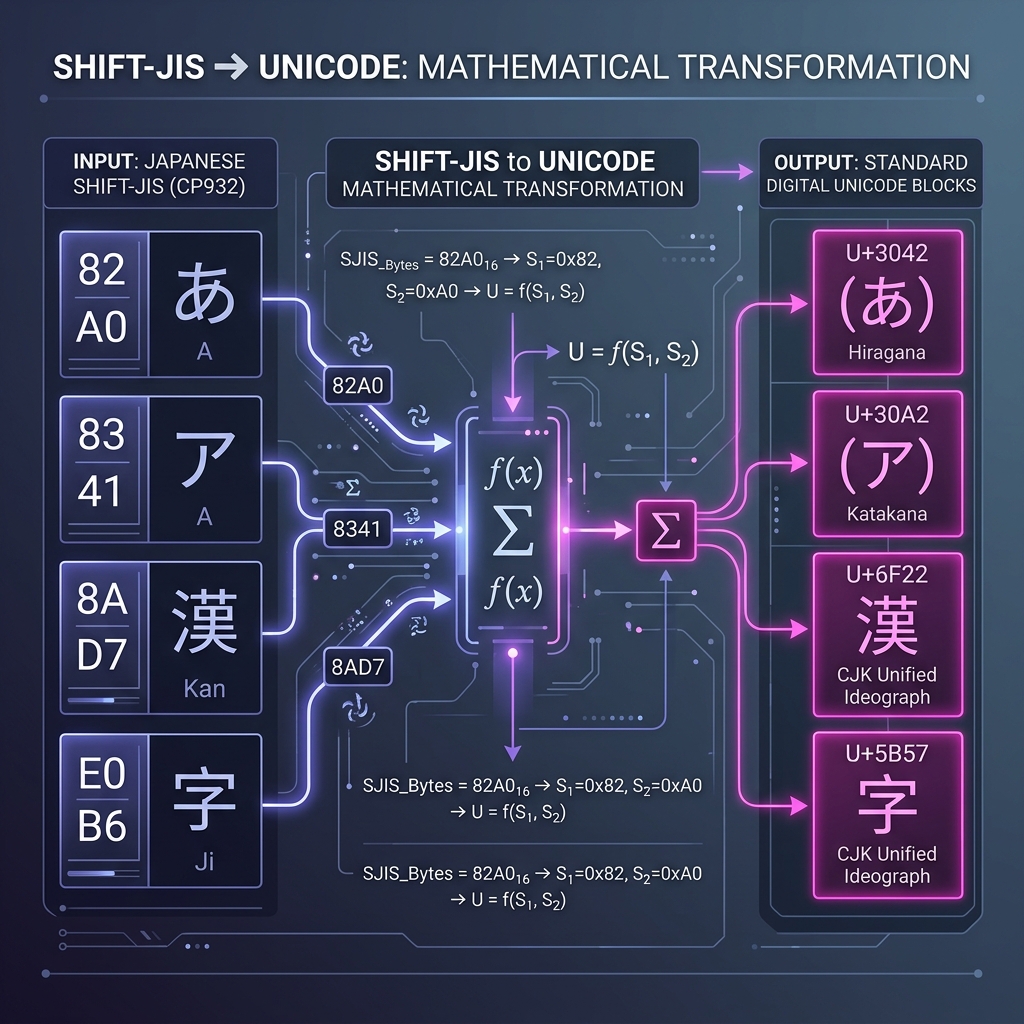
Our dedicated Shift-JIS to Unicode decoder eliminates this problem instantly without requiring you to download outdated language packs or change your operating system's locale to Japan. The complex mathematical conversion happens right inside your browser:
Byte Sequence Analysis: You paste your corrupted "mojibake" gibberish into the tool.
Reverse Extraction: The engine analyzes the corrupted UTF-8 string and mathematically reverses it back into its original raw byte values.
Double-Byte Mapping: It reads the bytes, carefully shifting between single-byte Hankaku (half-width Katakana) and double-byte Kanji, referencing the exact Shift-JIS encoding matrix.
Unicode Output: It maps those coordinates to the modern, universal CJK (Chinese, Japanese, and Korean) Unicode block, outputting perfectly readable standard Japanese text.
Because our logic relies on strict mathematical byte-mapping rather than predictive AI guessing, the translation is 100% accurate and lossless, preserving all rare characters perfectly.
Retro Gaming and Archival Preservation
This tool is heavily utilized by retro game translators, software engineers, and digital historians who need to migrate legacy datasets. Often, when old Japanese games are ROM-hacked or when early 2000s databases are dumped and imported into modern UTF-8 systems, the text becomes corrupted. By running the extracted strings through our converter, you can recover and modernize the data flawlessly.
Furthermore, because we have integrated an advanced external dictionary library, our tool uniquely supports two-way conversion! You can type standard Unicode Japanese and instantly encode it backward into corrupted Shift-JIS bytes—an incredibly useful feature for developers testing legacy systems.
Explore More Legacy Font Converters
Our platform offers a comprehensive suite of tools dedicated to recovering and modernizing legacy text across various regional encodings. If you work with other historical digital archives, be sure to explore our related tools:
Chinese Text Recovery: Need to fix corrupted Simplified Chinese characters? Use our GB2312 to Unicode Converter.
Russian & Cyrillic Recovery: Working with old Soviet-era Usenet posts? Check out our KOI8-R Cyrillic Converter.
Whether you are localizing a classic 16-bit JRPG, rescuing early internet archives, or migrating a 20-year-old database, our tool ensures your data remains accessible, readable, and permanently preserved in the modern Unicode era.
Expert Insights & FAQs
Quick answers to common questions about this utility.
5 Frequently Asked Questions
What exactly is Shift-JIS encoding?
Shift-JIS (Shift Japanese Industrial Standards) is a character encoding system developed in the 1980s by ASCII Corporation and Microsoft. It was designed to map thousands of Japanese Kanji, Hiragana, and Katakana characters into a digital format that early computer systems (like MS-DOS and early Windows) could process by shifting between single-byte and double-byte modes.
Why does my Japanese text look like gibberish (Mojibake)?
This phenomenon is known as 'Mojibake' (文字化け). It happens when you open an old Japanese text file or database dump on a modern computer. Modern systems expect text to be encoded in UTF-8 Unicode, but the file is encoded in Shift-JIS. Because the computer reads the legacy bytes incorrectly, it displays a chaotic mess of random symbols, accented letters, and squares.
Is this converter safe for confidential business data?
Yes, 100%. All decoding happens mathematically in your local web browser. Your text is never sent to our servers, ensuring total privacy for sensitive emails, legacy game localizations, or enterprise databases.
Does this tool support Half-width Katakana (Hankaku)?
Absolutely. One of the most unique features of Shift-JIS is its support for single-byte half-width Katakana (used heavily in retro computing and old mobile phones). Our engine perfectly distinguishes between single-byte Hankaku and double-byte Kanji, decoding both flawlessly into standard Unicode.
Can I convert standard Unicode back into Shift-JIS mojibake?
Yes! While modern web browsers don't natively support encoding into legacy formats, our custom engine includes an advanced lookup library that allows you to perfectly map standard Unicode text backward into Shift-JIS corrupted bytes. This is incredibly useful for retro software development and testing.