Regional China Font Converter — 100% Secure & Private.
GB2312 Legacy
Unicode
Source Input
Live Output
What is GB2312 Font?
GB2312 is a legacy encoding used for China regional script typing. Because it maps characters to standard keyboard keys rather than Unicode positions, this tool is required to convert GB2312 text into modern Unicode for web display and digital publishing.
Privacy & Offline Support
Our GB2312 font converter runs entirely in your browser. None of the text you type or convert is sent to any server. This makes it perfect for private document processing and ensures zero data leaks.
Quick Guide
1
Paste your GB2312 text into the source input area.
2
The tool will instantly convert it to standard Unicode below.
3
Click 'Copy Result' to use the Unicode text anywhere online.
4
Use the Vicerversa (Swap) button to convert from Unicode back to GB2312.
Technical Specs
Encoding Engine
Our high-performance engine uses a two-pass mapping system to resolve character swaps and script-specific vowel reordering rules, ensuring that your text remains linguistically accurate after conversion.
Unicode is the industry standard for consistent encoding, representation, and handling of text across most of the world's writing systems. Legacy fonts like GB2312 were designed before Unicode adoption.
Verified by Expert Editorial Team
GB2312 to Unicode Converter | Decrypt Legacy Chinese Characters
Instantly decode corrupted GB2312 and GBK double-byte Chinese mojibake back into perfectly readable standard Unicode characters for modern systems.
The GB2312 to Unicode Converter is an essential data-recovery utility designed to rescue and decode Simplified Chinese texts trapped in legacy double-byte encoding formats. Developed in 1980, the GB2312 character set was the absolute cornerstone of early Chinese computing, internet communication, software localization, and digital archives long before the global adoption of the modern UTF-8 Unicode standard.
The Legacy of GB2312 and GBK Encoding
In the early days of personal computing, operating systems like MS-DOS and Windows 95 needed a way to represent thousands of complex Chinese logograms using limited memory. The GB2312-80 standard (Guojia Biaozhun) solved this by mapping nearly 7,000 Simplified Chinese characters into a double-byte grid system. Later, Microsoft expanded this with GBK (Guojia Biaozhun Kuozhan) to support over 21,000 characters, including Traditional Chinese and rare symbols.
Because it was so deeply integrated into the Chinese internet infrastructure (often seen in HTML meta tags as charset="gb2312" or charset="gbk"), decades of digital literature, government records, enterprise databases, and video game localizations were permanently saved using this specific byte sequence.
The Problem with Chinese Mojibake (乱码)
As the tech industry shifted toward the universal UTF-8 standard to support global communication, a major technical conflict emerged. When a modern web browser, database client, or text editor attempts to read an old GB2312-encoded file using UTF-8 rendering rules, the double-byte sequences are catastrophically misinterpreted.
Instead of seeing standard Chinese logograms like "你好", the user is confronted with a wall of random, chaotic symbols, accented European letters, and question marks—a phenomenon widely known in China as Luànmǎ (乱码), and globally as Mojibake (e.g. ÎÒ°®Äã). Without a dedicated decoder, this historical data becomes completely unreadable.
How Our GB2312 Decoding Engine Works
Our dedicated GB2312 to Unicode decoder eliminates this problem instantly without requiring you to install ancient language packs or modify your operating system's locale settings. The mathematical conversion happens right inside your browser:
Byte Sequence Analysis: You paste your corrupted "mojibake" gibberish into the tool.
Reverse Extraction: The engine analyzes the corrupted UTF-8 string and mathematically reverses it back into its original raw byte values.
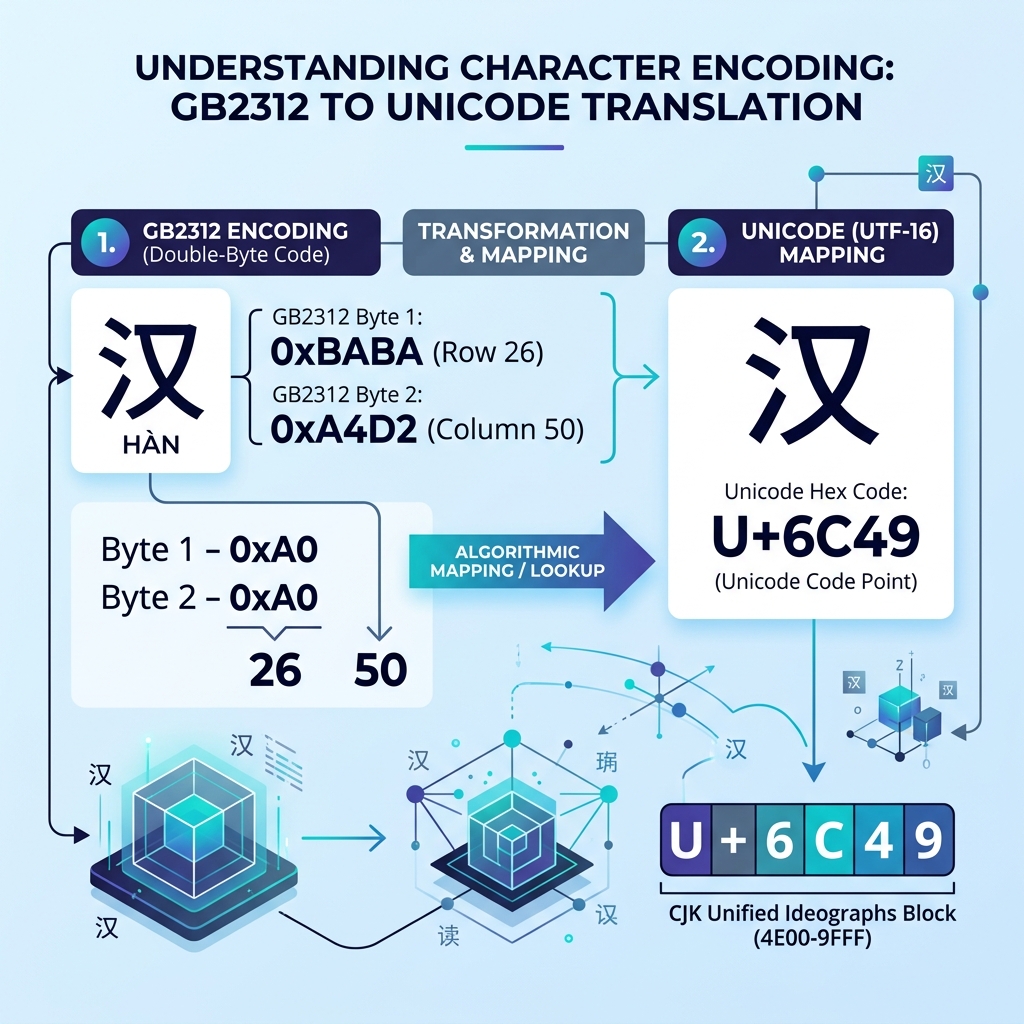
Double-Byte Mapping: It reads the bytes in pairs, referencing the exact GB2312/GBK encoding matrix to identify the correct grid coordinates.
Unicode Output: It maps those coordinates to the modern, universal U+4E00 CJK (Chinese, Japanese, and Korean) Unicode block, outputting perfectly readable Simplified Chinese text.
Because the conversion logic relies strictly on mathematical byte-mapping rather than machine learning or guessing, the translation is 100% accurate and lossless, preserving all rare characters and specific regional punctuations perfectly.
Database Recovery and Archival Preservation
This tool is heavily utilized by software engineers, database administrators, and historians who need to migrate legacy datasets. Often, when old MySQL or SQL Server databases containing GB2312 data are dumped and imported into modern UTF-8 databases without proper encoding flags, the entire dataset becomes corrupted. By running the extracted corrupted strings through our GB2312 converter, you can successfully recover and modernize the data without data loss.
Explore More Font Converters
Our platform offers a comprehensive suite of tools dedicated to recovering and modernizing legacy text across various regional encodings. If you work with other historical digital archives, be sure to explore our related tools:
Whether you are decoding a classic Chinese RPG, rescuing old email archives, or migrating a 20-year-old enterprise database, our tool ensures your data remains accessible, readable, and permanently preserved in the modern Unicode era.
Expert Insights & FAQs
Quick answers to common questions about this utility.
5 Frequently Asked Questions
What is the difference between GB2312 and GBK encoding?
GB2312 is the original official Simplified Chinese character set created in 1980, covering about 7,000 characters. GBK is an extension created later by Microsoft that is fully backwards compatible with GB2312 but adds over 14,000 additional characters, including Traditional Chinese and rare historical symbols.
Why does my Chinese text look like random symbols (Mojibake)?
This happens when a modern application (like a web browser or text editor) expects text to be encoded in the modern UTF-8 format, but the file was actually saved using the older double-byte GB2312 or GBK format. Because the computer is reading the bytes incorrectly, it displays "mojibake" (乱码).
Is this converter safe for sensitive or confidential data?
Yes, absolutely. All decoding happens mathematically in your local web browser using JavaScript. Your text is never uploaded to any external server, ensuring 100% privacy for sensitive databases or personal emails.
Can I convert standard Unicode back into GB2312 mojibake?
No. Modern web browsers natively support decoding legacy formats into Unicode, but they do not support encoding Unicode back into legacy GB2312. This tool acts as a dedicated, one-way recovery utility to modernize old text.
Does this tool support Traditional Chinese characters?
Yes! Because this decoder actually processes the extended GBK character set (which fully envelops the original GB2312 set), it perfectly decodes Traditional Chinese characters that were saved using the GBK standard.