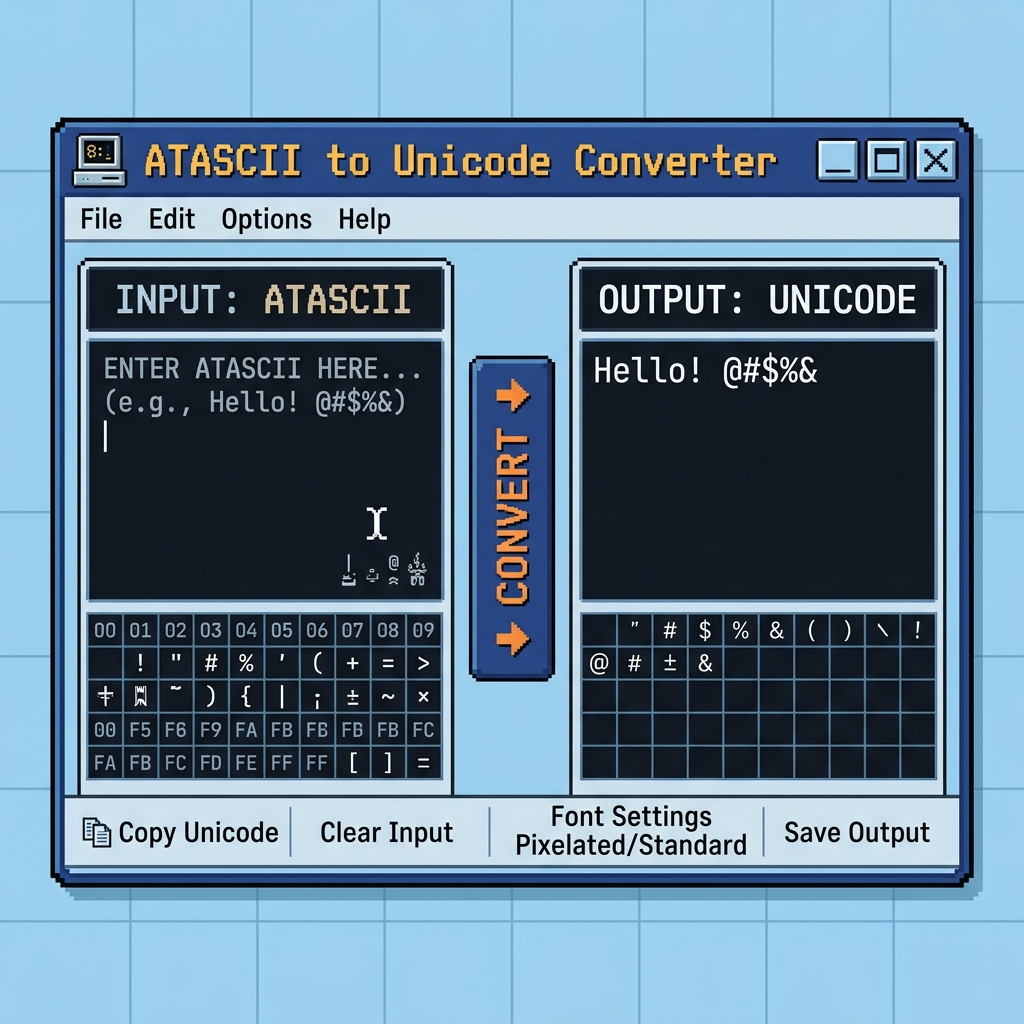
Regional Russia/CIS Font Converter — 100% Secure & Private.
KOI8-R Legacy
Unicode
Source Input
Live Output
What is KOI8-R Font?
KOI8-R is a legacy encoding used for Russia/CIS regional script typing. Because it maps characters to standard keyboard keys rather than Unicode positions, this tool is required to convert KOI8-R text into modern Unicode for web display and digital publishing.
Privacy & Offline Support
Our KOI8-R font converter runs entirely in your browser. None of the text you type or convert is sent to any server. This makes it perfect for private document processing and ensures zero data leaks.
Quick Guide
1
Paste your KOI8-R text into the source input area.
2
The tool will instantly convert it to standard Unicode below.
3
Click 'Copy Result' to use the Unicode text anywhere online.
4
Use the Vicerversa (Swap) button to convert from Unicode back to KOI8-R.
Technical Specs
Encoding Engine
Our high-performance engine uses a two-pass mapping system to resolve character swaps and script-specific vowel reordering rules, ensuring that your text remains linguistically accurate after conversion.
Unicode is the industry standard for consistent encoding, representation, and handling of text across most of the world's writing systems. Legacy fonts like KOI8-R were designed before Unicode adoption.
Verified by Expert Editorial Team
KOI8-R to Unicode Converter | Cyrillic Legacy Font Tool
Convert legacy Russian and Cyrillic KOI8-R encodings to modern Unicode effortlessly. Restore historical emails, Usenet posts, and regional publishing data perfectly into universally readable Unicode.
The KOI8-R to Unicode Converter is an essential digital utility designed to rescue and modernize Cyrillic texts trapped in the archaic KOI8-R legacy encoding system. Developed in the late 1980s and officially standardized in 1993, KOI8-R (Kod Obmena Informatsiey, 8-bit) became the de facto standard for Russian computing, internet communication, email, and Usenet newsgroups before the widespread adoption of Unicode.
The Legacy of KOI8-R Encoding
The KOI8-R encoding (RFC 1489) was a game-changer for the Russian Internet (Runet) in the 1990s. Its most brilliant design feature was its phonetic fallback mechanism. In KOI8-R, the Cyrillic letters are arranged so that their phonetic English equivalents share the exact same lower 7 bits. If the 8th bit is stripped (which often happened in early email and networking systems), a Cyrillic letter like 'А' naturally downgrades to the Latin letter 'A', keeping the text somewhat readable.
The Problem with Legacy Cyrillic Encoding
Despite its brilliance, KOI8-R relies on assigning Cyrillic characters to the upper-half of the ASCII table (128-255). Today, if you open a KOI8-R encoded text file in a modern editor expecting UTF-8 or Windows-1252, the text will appear as incomprehensible European characters (e.g., "юТЙЧЕФ"). This "Mojibake" makes decades of valuable literature, forums, and archives completely inaccessible to modern digital platforms.
How Our Conversion Engine Works
Our KOI8-R to Unicode Converter resolves this data isolation by permanently translating the underlying binary data into proper Unicode. Unicode provides a universal, standardized mathematical ID for every character in almost every written language. The Cyrillic script is fully supported within the Unicode Standard.
KOI8-R Character Mapping (Character Map)
The table below provides a demonstration of the character map for how common KOI8-R legacy characters are mathematically mapped to their official Cyrillic Unicode equivalents.
KOI8-R Input (Hex)
Latin Fallback
Cyrillic Unicode Output
Unicode Hex
0xC1
a
а
U+0430
0xE1
A
А
U+0410
0xC2
b
б
U+0431
0xD7
w
в
U+0432
Modern Database Preservation
For research institutions, regional publishers, and government archives in Russia and CIS nations, upgrading legacy text to Unicode is a critical step for long-term preservation. By standardizing your archives with our tool, your regional texts instantly become globally accessible, searchable, and easily shareable on modern platforms like social media. If you manage extensive archives spanning multiple regional scripts, consider also checking out our Bijoy Bengali Converter and our Baraha Converter to ensure your entire historical database is Unicode-compliant and future-proofed.
Expert Insights & FAQs
Quick answers to common questions about this utility.
3 Frequently Asked Questions
Why is my Russian text showing up as European gibberish?
This happens because the text was encoded using the legacy KOI8-R standard. When viewed on a modern system expecting UTF-8 or Windows-1251, the computer falls back to displaying the wrong characters. Our converter fixes this by permanently changing those characters to their proper Cyrillic Unicode equivalents.
Can I convert text back from Unicode to KOI8-R?
Yes! Our tool features a bidirectional engine. By using the Viceversa (Swap) button, you can paste standard Unicode text and convert it back into the KOI8-R legacy format. This is incredibly useful for interfacing with legacy systems or older DTP software.
Is my data secure during conversion?
Absolutely. Our conversion engine runs 100% locally in your web browser. Your text is never transmitted to our servers, ensuring complete privacy and security for sensitive or confidential documents.