Regional India/Sri Lanka Font Converter — 100% Secure & Private.
Bamini Legacy
Unicode
Source Input
Live Output
What is Bamini Font?
Bamini is a legacy encoding used for India/Sri Lanka regional script typing. Because it maps characters to standard keyboard keys rather than Unicode positions, this tool is required to convert Bamini text into modern Unicode for web display and digital publishing.
Privacy & Offline Support
Our Bamini font converter runs entirely in your browser. None of the text you type or convert is sent to any server. This makes it perfect for private document processing and ensures zero data leaks.
Quick Guide
1
Paste your Bamini text into the source input area.
2
The tool will instantly convert it to standard Unicode below.
3
Click 'Copy Result' to use the Unicode text anywhere online.
4
Use the Vicerversa (Swap) button to convert from Unicode back to Bamini.
Technical Specs
Encoding Engine
Our high-performance engine uses a two-pass mapping system to resolve character swaps and script-specific vowel reordering rules, ensuring that your text remains linguistically accurate after conversion.
Unicode is the industry standard for consistent encoding, representation, and handling of text across most of the world's writing systems. Legacy fonts like Bamini were designed before Unicode adoption.
Verified by Expert Editorial Team
Bamini to Unicode Converter | Tamil Font Recovery Tool
Instantly convert legacy Bamini Tamil fonts into perfectly formatted standard Unicode. Recover old documents and make your Tamil text universally readable.
The Bamini to Unicode Converter is an essential tool for preserving and modernizing Tamil digital literature, academic research, and personal documents. In the early days of digital publishing, the lack of Unicode support forced Tamil typists to rely on proprietary "legacy" fonts like Bamini to render their beautiful script on screen.
The Legacy Font Problem
Typing Tamil on a standard English (QWERTY) keyboard is a complex challenge because Tamil features pre-base vowels (modifiers that appear before the consonant they apply to) and complex ligatures. To solve this in the 1990s and early 2000s, fonts like Bamini were created. These fonts acted as visual overlays.
When a typist struck specific English keys, the Bamini font would visually render the corresponding Tamil characters. However, the underlying data saved to the hard drive remained standard English letters. If you attempt to open a Bamini document today on a smartphone, an iPad, or any system without the exact font installed, all you will see is a chaotic string of English characters (e.g., rge rtgwt4).
How the Bamini Decoder Works
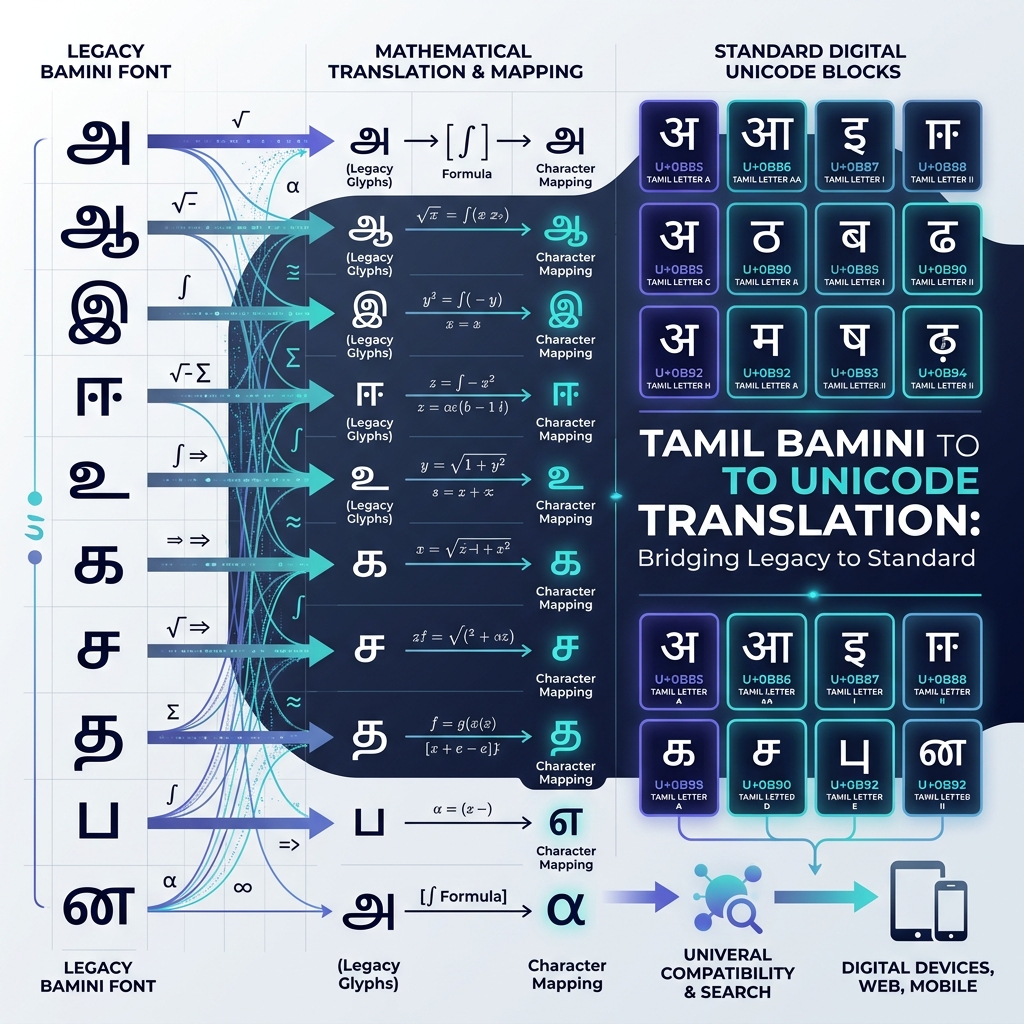
Our proprietary converter engine doesn't just swap fonts; it translates the underlying raw data. When you paste your corrupted text into the converter, the engine performs complex character rearranging (such as swapping pre-base vowels into their correct logical positions) and maps the legacy ASCII codes directly to the modern Tamil Unicode Block (U+0B80–U+0BFF).
This process results in text that is 100% accurate, standardized, and natively readable by every modern operating system, search engine, and digital device on the planet.
Why Unicode Matters
Converting your historical documents to Unicode ensures they are permanently preserved. Unicode text is searchable, indexable by Google, selectable, and can be read by text-to-speech accessibility tools. Whether you are digitizing an old Tamil novel, recovering archival newspaper databases, or just trying to read a family letter, upgrading to Unicode brings your text into the modern era.
Explore More Font Converters
If you work heavily with legacy archives or desktop publishing, you might encounter other problematic non-standard encodings. We offer a full suite of highly accurate data recovery tools:
Don't let older regional encodings lock away your valuable data. Use our converter to modernize and rescue your Tamil text today.
Expert Insights & FAQs
Quick answers to common questions about this utility.
4 Frequently Asked Questions
What is the Bamini font?
Bamini is a very popular legacy Tamil font. Before the global adoption of Unicode, typing complex Tamil scripts (which include pre-base vowels and combinations) on an English keyboard required custom fonts. Bamini hijacked English keystrokes and painted them as Tamil characters on the screen.
Why does my Bamini text look like English gibberish?
If you copy text typed in Bamini and paste it somewhere that doesn't have the font installed (like an email or a modern website), the computer only sees the original Latin keystrokes you typed (e.g., 'rge rtgwt4'). It strips away the visual mask, revealing the underlying English letters.
How does this converter fix my text?
Our converter uses a deep encoding translation engine that analyzes your legacy ASCII keystrokes and mathematically maps them back to the official Tamil block in the Unicode Standard. This transforms your text into genuine, globally recognized Tamil characters.
Is this converter private and secure?
Yes, completely! The conversion happens instantly via JavaScript directly inside your web browser. Your text is never uploaded to an external server or saved in a database, ensuring total privacy for your documents.