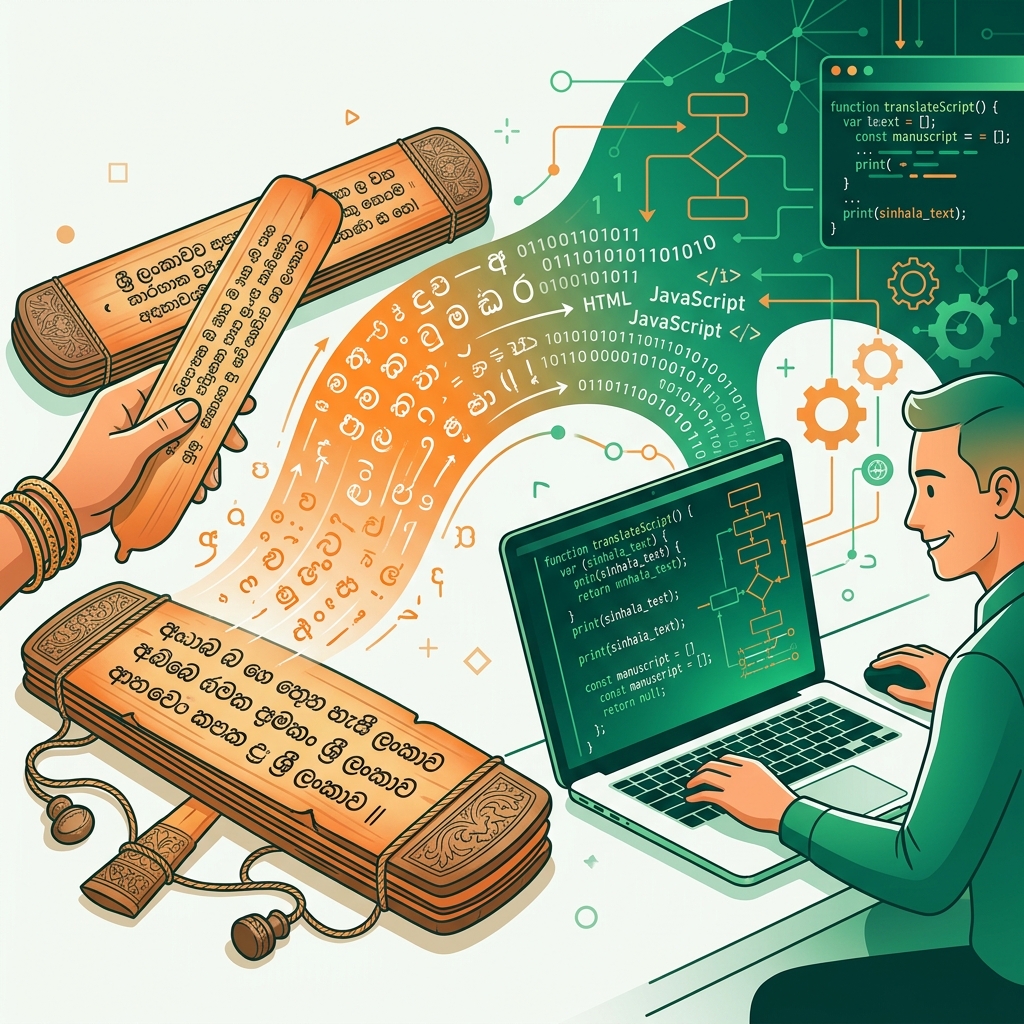
Regional Sri Lanka Font Converter — 100% Secure & Private.
Sinhala DL Legacy
Unicode
Source Input
Live Output
What is Sinhala DL Font?
Sinhala DL is a legacy encoding used for Sri Lanka regional script typing. Because it maps characters to standard keyboard keys rather than Unicode positions, this tool is required to convert Sinhala DL text into modern Unicode for web display and digital publishing.
Privacy & Offline Support
Our Sinhala DL font converter runs entirely in your browser. None of the text you type or convert is sent to any server. This makes it perfect for private document processing and ensures zero data leaks.
Quick Guide
1
Paste your Sinhala DL text into the source input area.
2
The tool will instantly convert it to standard Unicode below.
3
Click 'Copy Result' to use the Unicode text anywhere online.
4
Use the Vicerversa (Swap) button to convert from Unicode back to Sinhala DL.
Technical Specs
Encoding Engine
Our high-performance engine uses a two-pass mapping system to resolve character swaps and script-specific vowel reordering rules, ensuring that your text remains linguistically accurate after conversion.
Unicode is the industry standard for consistent encoding, representation, and handling of text across most of the world's writing systems. Legacy fonts like Sinhala DL were designed before Unicode adoption.
Verified by Expert Editorial Team
Sinhala DL Legacy Fonts to Unicode Converter | Sri Lanka Encoding Tool
Convert legacy Sinhala DL fonts (like DL-Manel, DL-Araliya) to modern Unicode effortlessly. Restore historical Sri Lankan texts, old websites, and publishing data perfectly into universally readable Unicode.
The Sinhala DL to Unicode Converter is a state-of-the-art digital utility precision-engineered to rescue, translate, and modernize Sinhala texts that are trapped within the archaic DL legacy encoding systems. Throughout the 1990s and early 2000s in Sri Lanka, before the widespread adoption and standardization of complex scripts within the Unicode framework, "DL" fonts (most notably DL-Manel, DL-Araliya, and similar typefaces) became the undisputed standard for Sri Lankan desktop publishing, government communications, local journalism, and internet publishing. These fonts were incredibly popular because they allowed users to type beautiful Sinhala script using a standard English QWERTY keyboard. However, as global digital infrastructure modernized, files encoded in these legacy formats became increasingly inaccessible, resulting in massive data isolation. When opened on modern devices, these beautiful Sinhala documents render as an incomprehensible string of random English letters and symbols. Our tool bridges this critical technological gap, providing a flawless, 100% accurate conversion pathway to recover your invaluable Sinhala data.
The Comprehensive History of Sinhala DL Fonts
The story of Sinhala DL fonts represents a highly creative and adaptive chapter in the evolution of localized digital communication in South Asia. Before the advent of Unicode, which assigned a unique mathematical identifier to every character across all human languages, complex scripts with intricate ligatures (like Sinhala) were extraordinarily difficult to implement on standard computer systems. To bypass this limitation, software engineers and typographers in Sri Lanka created "hacked" fonts. In these legacy DL systems (such as DL-Manel), the physical keys on a standard QWERTY keyboard were mapped directly to specific Sinhala visual glyphs rather than their corresponding English letters. For example, typing the English letter 'f' would visually produce the Sinhala hal kirima (්), and typing 'y' would produce the letter 'හ' (ha). This clever visual trick allowed Sri Lankans to type natively on standard hardware without complex software drivers. For over a decade, this was a revolutionary leap forward, enabling the creation of the very first Sinhala web portals, local word processing documents, and massive digital literature databases.
Understanding the Legacy Encoding Trap
Despite its widespread utility and early success, the hacked 8-bit architecture of Sinhala DL fonts ultimately laid the groundwork for a massive digital preservation crisis. The core issue stems from the fact that the underlying binary data was never actually Sinhala—it was just standard English ASCII text being wearing a "mask." If you wrote the word "ලංකා" (Lanka) using DL-Manel, the computer actually saved the English letters ",xld". As long as you had the DL-Manel font installed, it looked perfectly fine. However, in the modern era of smartphones, cloud computing, and social media, devices expect pure UTF-8 Unicode and do not have these legacy fonts installed. Consequently, if you attempt to open an old, archival DL-encoded text document or legacy database dump today, the software strips away the mask and reveals the raw English ASCII underneath (e.g., "fybmmn 0985' .m"). This severe incompatibility renders decades of invaluable Sinhala literature, academic research, governmental archives, and nostalgic forum discussions completely locked away and unreadable to modern users and search engines.
How Our Advanced Conversion Engine Operates
Our Sinhala DL to Unicode Converter completely resolves this pervasive data isolation crisis by permanently and accurately translating the underlying pseudo-English ASCII data of your legacy text into proper, modern Sinhala Unicode codepoints. The engine is powered by a highly sophisticated parsing algorithm that understands the complex, multi-character ligatures and contextual positioning rules inherent to the Sinhala script. Because Sinhala utilizes pre-base vowels (vowels that appear visually before a consonant but are typed afterward logically), a simple one-to-one character replacement is insufficient. Our converter meticulously analyzes the input string, identifying consonant clusters, hal kirima modifiers, repaya marks, and kombuwa vowels, and intelligently restructures them into the exact sequential order mandated by the strict Unicode standard. This ensures a 100% recovery rate for your historical documents, guaranteeing grammatical and structural perfection.
Sinhala DL Character Mapping (Character Map)
To provide absolute transparency regarding our conversion mechanics, the comprehensive table below serves as a demonstration character map. It clearly illustrates how common Sinhala DL pseudo-ASCII keystrokes are mathematically mapped and restructured into their official, universally recognized Sinhala Unicode equivalents.
DL-Manel Input (ASCII)
Sinhala Unicode Output
Unicode Hex
y
හ
U+0DC4
f
් (Hal Kirima)
U+0DCA
,
ල
U+0DBD
x
ං (Anusvaraya)
U+0D82
l
ක
U+0D9A
d
ා (Aela Pilla)
U+0DCF
,xld (Word Example)
ලංකා (Lanka)
Parsed Sequence
Crucial Modern Database Preservation Strategies
For prominent research institutions, regional publishing houses, national media conglomerates, and government archival departments operating in Sri Lanka, upgrading and migrating legacy textual data to the Unicode standard is an absolutely critical, non-negotiable step for long-term digital preservation and cultural heritage maintenance. By proactively standardizing your vast historical archives with our specialized conversion tool, your regional texts are instantly transformed. They become globally accessible, highly searchable by modern search engines, and easily shareable across all modern digital platforms, smartphones, and social media networks. If you are a digital archivist managing extensive, multi-lingual South Asian databases, we highly recommend that you also explore and utilize our Bijoy Bengali Converter and our highly acclaimed Baraha Indic Converter. Utilizing these interconnected tools ensures your entire historical database ecosystem is fully Unicode-compliant, completely future-proofed, and protected against the ravages of digital obsolescence.
The Evolution of Sinhala Digital Typography
The transition from DL legacy fonts to Unicode also heralded a golden age for Sinhala digital typography. In the legacy era, font designers were severely constrained by the chaotic, non-standardized mapping environments. Because physical keys on a keyboard produced specific ASCII codes, the visual glyph of a font had to be rigidly tied to that specific code. This meant that if a user did not possess the exact specific DL font installed on their local machine, the document was entirely unreadable. Unicode fundamentally shattered this limitation by separating the mathematical identity of a character from its visual representation. Today, beautiful Sinhala typography can flourish across the web natively, utilizing web-safe fonts like Iskoola Pota and sophisticated CSS styling without any fear of data corruption. This converter acts as the essential bridge, pulling your data out of the typographical dark ages and into the modern, expressive web.
Expert Insights & FAQs
Quick answers to common questions about this utility.
4 Frequently Asked Questions
Why is my Sinhala text appearing as a mess of English letters and symbols like 'fybmmn'?
This occurs because the text was originally saved using a legacy Sinhala DL font (like DL-Manel). These old systems tricked the computer by using standard English letters (ASCII) but rendering them visually as Sinhala characters. When you view this file on a modern smartphone or computer that lacks the specific DL font, the operating system reveals the raw English letters underneath. Our powerful converter permanently fixes this issue by mathematically translating those pseudo-English letters into their proper, universally recognized Sinhala Unicode equivalents.
Does this utility handle complex Sinhala ligatures and pre-base vowels?
Absolutely! Sinhala contains complex rendering rules, such as vowels (like the Kombuwa) that are typed after a consonant but displayed before it. Our conversion engine utilizes a sophisticated parsing algorithm that identifies these contextual anomalies and restructures the characters into the exact sequential order mandated by the strict Unicode standard.
Is my highly sensitive corporate or personal data secure during the conversion process?
Yes, unequivocally. We prioritize your privacy above all else. Our conversion engine is designed to run 100% locally within your own web browser using client-side JavaScript. This means your text is processed immediately on your device and is never, ever transmitted to our external servers. You can safely convert highly sensitive, confidential, or proprietary documents with complete peace of mind.
Can I batch process large volumes of Sinhala DL text at once?
Yes. Our highly optimized conversion engine is built to handle massive text payloads seamlessly. You can easily copy and paste entire chapters of books, lengthy archival logs, or extensive database dumps into the source input box, and the engine will instantly render the Unicode output without any noticeable performance lag.