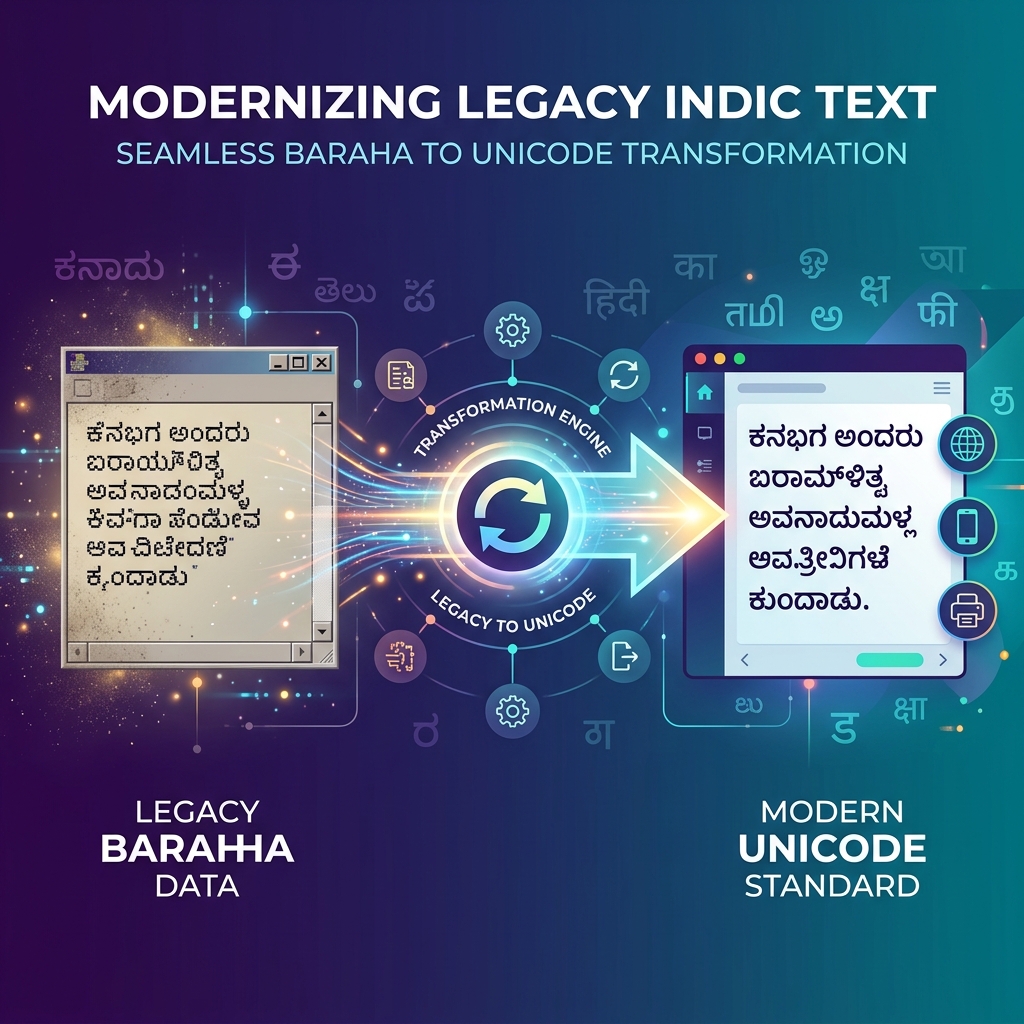
Regional India (Karnataka) Font Converter — 100% Secure & Private.
Baraha Legacy
Unicode
Source Input
Live Output
What is Baraha Font?
Baraha is a legacy encoding used for India (Karnataka) regional script typing. Because it maps characters to standard keyboard keys rather than Unicode positions, this tool is required to convert Baraha text into modern Unicode for web display and digital publishing.
Privacy & Offline Support
Our Baraha font converter runs entirely in your browser. None of the text you type or convert is sent to any server. This makes it perfect for private document processing and ensures zero data leaks.
Quick Guide
1
Paste your Baraha text into the source input area.
2
The tool will instantly convert it to standard Unicode below.
3
Click 'Copy Result' to use the Unicode text anywhere online.
4
Use the Vicerversa (Swap) button to convert from Unicode back to Baraha.
Technical Specs
Encoding Engine
Our high-performance engine uses a two-pass mapping system to resolve character swaps and script-specific vowel reordering rules, ensuring that your text remains linguistically accurate after conversion.
Unicode is the industry standard for consistent encoding, representation, and handling of text across most of the world's writing systems. Legacy fonts like Baraha were designed before Unicode adoption.
Verified by Expert Editorial Team
Baraha to Unicode Converter | S. India Font Tool
Convert legacy Baraha Kannada and Telugu fonts to modern Unicode effortlessly. Restore historical documents and regional publishing data perfectly into universally readable Unicode.
The Baraha to Unicode Converter is an essential digital utility designed to rescue and modernize Kannada and Telugu texts trapped in the archaic Baraha legacy font system. Developed in the late 1990s, Baraha revolutionized typing for South Indian languages, becoming the de facto standard for journalists, authors, and everyday users. While pioneering for its time, Baraha relied on non-standard ASCII mapping, meaning documents created in it cannot be easily shared, searched, or viewed on modern digital devices without the specific font installed. Our converter instantly transforms these broken texts into pure, universally compatible Unicode.
The Legacy of the Baraha Software
The Baraha software was an absolute game-changer when it launched in 1998. It utilized a highly intuitive phonetic keyboard layout, making it easy for users to type complex Kannada and Telugu scripts using a standard English QWERTY keyboard. Its immense popularity, both as a free tool for personal use and a commercial tool for publishing, led to massive archives of literature, official documents, blogs, and regional newspapers being completely encoded in Baraha legacy fonts.
However, before Unicode became the global standard for text representation on the web, Baraha (much like Nudi and other regional tools) had to rely on a clever workaround: visually "hijacking" English ASCII characters. It assigned visually complex regional glyphs to standard English key codes. This meant the visual output was correct, but the underlying data was fragile and incompatible with the emerging internet.
The Problem with Legacy Baraha Encoding
Legacy fonts function purely as a visual "mask." If you type a specific sequence on the Baraha phonetic keyboard, the screen displays a beautiful Kannada or Telugu word, but the underlying data saved to your hard drive remains a string of English letters and symbols. If you copy a Baraha-typed document and paste it into an email, WhatsApp, or a web browser that lacks the Baraha font, the text immediately reverts to incomprehensible English gibberish (e.g., "uykt7uv ut5ry").
This legacy trap severely hinders modern data retrieval and archiving. Decades of valuable literature, government records, and cultural history locked in Baraha formats cannot be reliably searched, parsed by natural language processing (NLP) algorithms, or indexed by modern search engines. They remain digitally isolated from the modern web.
How Our Conversion Engine Works
Our Baraha to Unicode Converter resolves this data isolation by permanently translating the underlying binary data into proper Unicode. Unicode provides a universal, standardized mathematical ID for every character in almost every written language. The Kannada and Telugu scripts are fully supported within the Unicode Standard (blocks U+0C80–U+0CFF and U+0C00–U+0C7F respectively).
When you input text encoded in a Baraha legacy font, our engine analyzes the raw ASCII data. Utilizing precise transliteration algorithms that account for unique vowel modifiers, half-letters, and complex conjuncts, it mathematically maps the ASCII input directly to the pristine Unicode block by calculating the required byte shift. The output is pure, uncorrupted Unicode text that renders beautifully on all modern browsers, smartphones, and operating systems.
Baraha Keyboard Character Mapping
The table below provides a simplified demonstration of how common Baraha legacy keystrokes are mapped to their official Unicode equivalents, revealing the complex parsing required to fix these old documents.
Baraha Input (ASCII)
Phonetic Target
Kannada Unicode Output
Unicode Hex
u
u
ಉ
U+0C89
k
ka
ಕ
U+0C95
g
ga
ಗ
U+0C97
m
ma
ಮ
U+0CAE
Official Use in Government and Academia
For research institutions, regional publishers, and state government archives in South India, upgrading legacy text to Unicode is a critical step for long-term preservation and compliance. During the early days of regional computing, vast amounts of official government orders, academic research, and literature were digitized using Baraha. Converting these official records into Unicode is now an essential mandate for government digital transformation initiatives, ensuring that historical data is permanently accessible and compliant with open-data standards.
By standardizing your archives with our tool, your regional texts instantly become globally accessible, searchable, and easily shareable on modern platforms like social media. If you manage extensive archives spanning multiple regional scripts, consider also checking out our Nudi Converter and our Anu Telugu Converter to ensure your entire historical database is Unicode-compliant and future-proofed.
Expert Insights & FAQs
Quick answers to common questions about this utility.
3 Frequently Asked Questions
Why is my Baraha text showing up as English gibberish?
This happens because the text was typed using a legacy non-Unicode font. When viewed on a device that doesn't have the exact Baraha font installed, the computer falls back to displaying the raw English characters that were originally typed. Our converter fixes this by permanently changing those characters to their proper Unicode equivalents.
Can I convert text back from Unicode to Baraha?
Yes! Our tool features a bidirectional engine. By using the Viceversa (Swap) button, you can paste standard Unicode text and convert it back into the Baraha legacy format. This is incredibly useful if you need to edit older documents in legacy DTP software like Adobe PageMaker.
Is my data secure during conversion?
Absolutely. Our conversion engine runs 100% locally in your web browser using JavaScript. Your text is never transmitted to our servers, ensuring complete privacy and security for sensitive or confidential documents.