
For years, QR (Quick Response) codes were considered a gimmick in Western marketing—a futuristic square that required users to download a clunky, third-party scanning app just to visit a mobile website. Then, two major shifts occurred: Apple and Google integrated native QR scanning directly into their default camera apps, and the global pandemic necessitated touchless interactions.
Today, the QR code is the most efficient bridge between the physical and digital worlds. From restaurant menus to Super Bowl commercials, they have become a staple of modern consumer interaction. In this guide, we will explore the strategic differences between QR code types, best practices for deploying them in marketing campaigns, and how to utilize them without frustrating your users.
Static vs. Dynamic QR Codes: The Crucial Difference
Before you print 10,000 flyers or launch a billboard campaign, you must understand the difference between static and dynamic QR codes. A mistake here can ruin an entire marketing budget.
Static QR Codes
A static QR code permanently hardcodes the destination data (like a URL, Wi-Fi password, or text string) directly into the black and white pixel pattern.
- Pros: They never expire, they don't rely on a third-party routing server, and they are completely free to generate using our QR Generator.
- Cons: If you make a typo in the URL, or if you need to change the destination website a month later, you cannot. You must print an entirely new code. Additionally, the longer the URL, the denser and harder to scan the code becomes.
Dynamic QR Codes
A dynamic QR code does not contain your final destination URL. Instead, it contains a short, intermediary URL that redirects the user to your final destination.
- Pros: You can change the final destination URL at any time without changing the printed QR code. Because the encoded URL is short, the QR code pattern is less dense and scans faster. They also allow for scan tracking and analytics.
- Cons: They usually require a subscription service to maintain the routing link.
Pro Tip: You can create your own free "dynamic" QR code by first using our URL Shortener to create a redirect link, and then generating a static QR code of that short link. If you control the redirect, you control the destination.
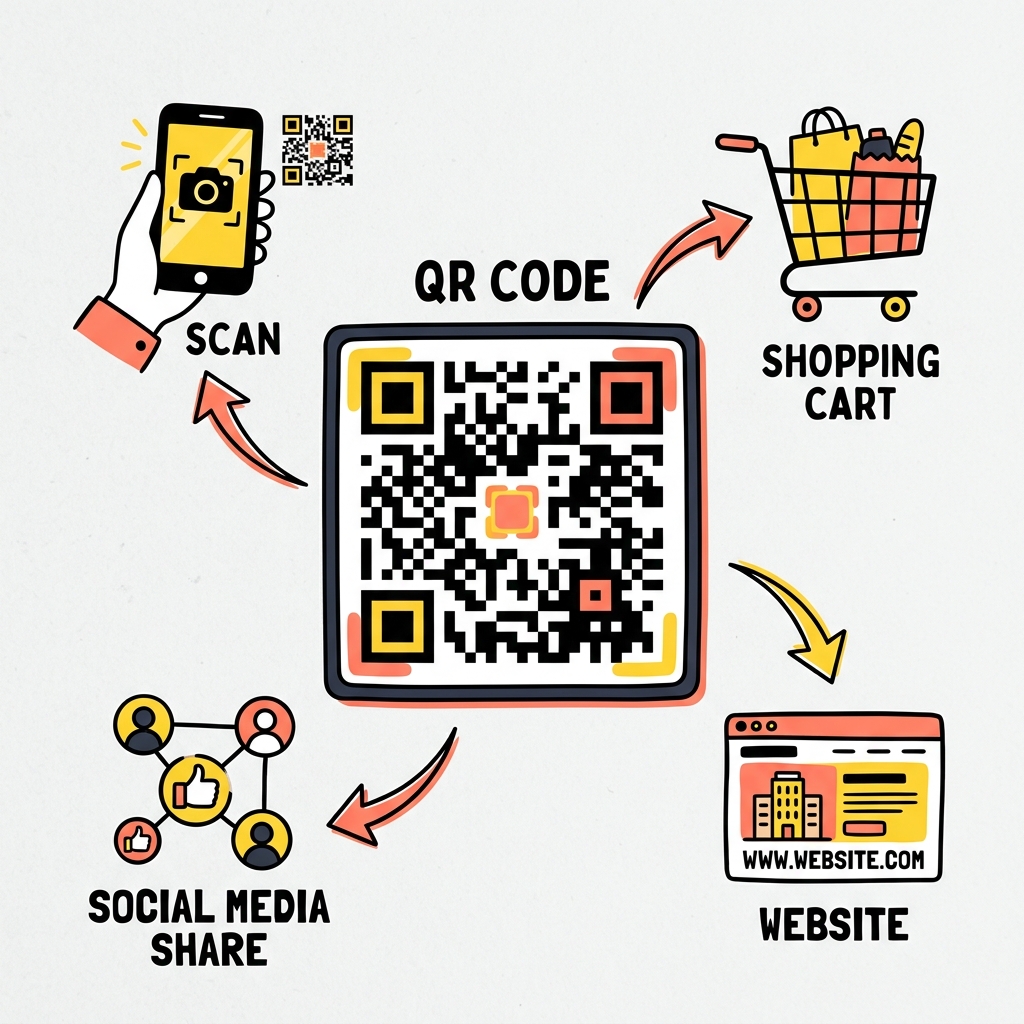
QR codes act as immediate physical portals to digital marketing campaigns.
Best Practices for QR Code Design and Placement
A common mistake marketers make is treating a QR code purely as a design element rather than a functional tool. To maximize scan rates, you must adhere to several physical and psychological principles.
- Always Provide a Call-to-Action (CTA): Do not just slap a QR code on a poster and hope people scan it. Tell them why they should. "Scan to view our menu," "Scan for 20% off," or "Scan to download the app."
- Respect the Quiet Zone: QR codes require a blank margin around them (the "quiet zone") for cameras to recognize the optical alignment squares. Do not crowd the code with text or graphics.
- Size Matters: The minimum size for a printed QR code is typically 2x2 centimeters (0.8x0.8 inches). However, the size must scale with the scanning distance. A code on a business card can be small; a code on a billboard must be massive.
- High Contrast is Mandatory: While modern tools allow you to change the color of your QR code, you must maintain high contrast between the dark foreground and light background. Inverse codes (white pixels on a black background) fail on many older scanners.
Innovative Use Cases
The versatility of the QR code format extends far beyond simply opening a website. Because the data standard (ISO/IEC 18004) supports various URI schemes, you can trigger complex actions on a user's device.
- vCard Integration: Add a QR code to the back of your physical business card. When scanned, it instantly prompts the user's phone to save your name, phone number, email, and company directly to their contacts app.
- Wi-Fi Provisioning: Cafes, hotels, and offices can generate a code containing the network SSID and password. Guests scan it and are instantly connected without typing complex strings.
- Pre-filled Emails and SMS: A code can be structured to open the user's email client, address it to your support team, and pre-fill the subject line, dramatically reducing friction for customer feedback.
If you are working with incoming codes and need to verify their safety before clicking, or need to extract data from a code on your computer screen, you can use our web-based QR Scanner. For developers looking to integrate scanning into their own apps, the Google ML Kit Barcode Scanning API is the industry standard for fast, on-device recognition.
Conclusion
The QR code is no longer a novelty; it is a fundamental utility of modern commerce and marketing. By understanding the underlying mechanics, ensuring high-contrast design, and always providing a compelling reason for the user to pull out their camera, you can seamlessly connect your physical marketing assets to your digital conversion funnels.