Regional Morocco/Algeria Font Converter — 100% Secure & Private.
Tifinagh (Amazigh) Legacy
Unicode
Source Input
Live Output
What is Tifinagh (Amazigh) Font?
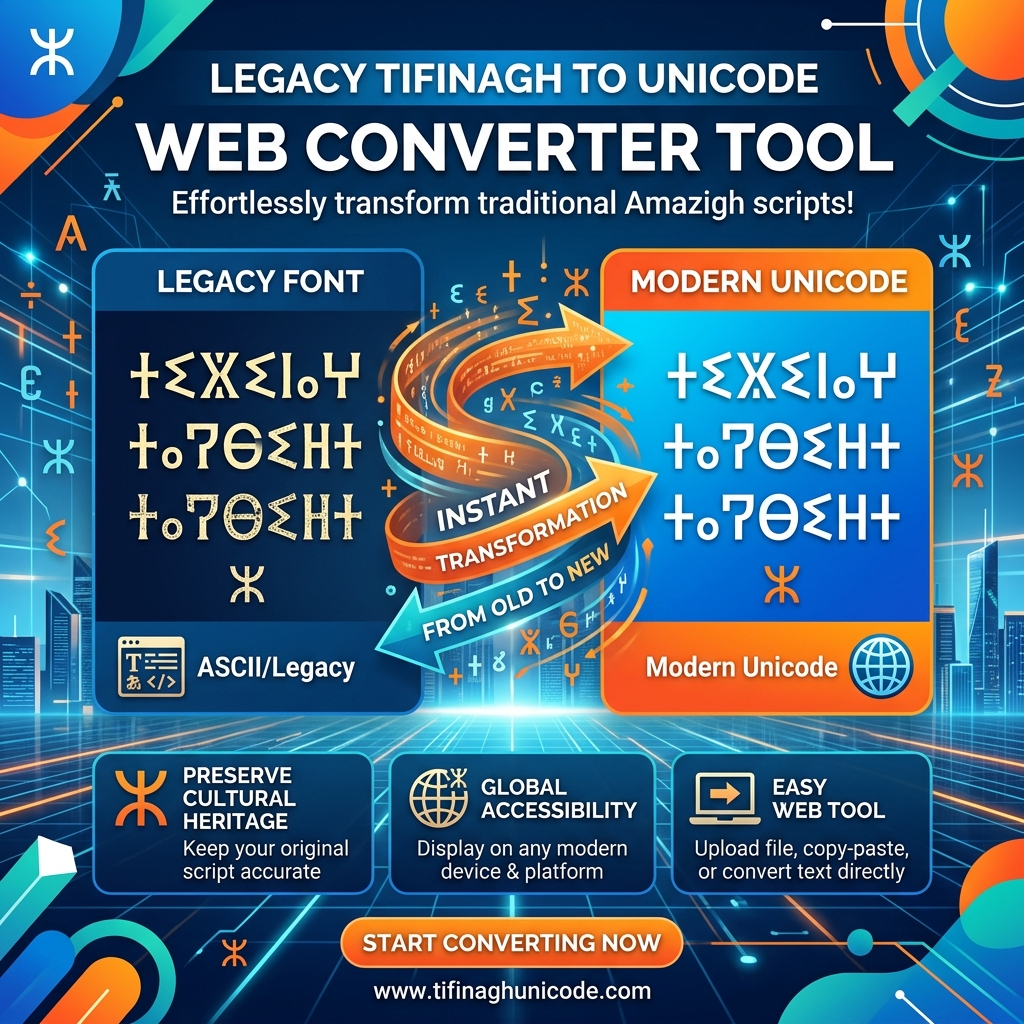
Tifinagh (Amazigh) is a legacy encoding used for Morocco/Algeria regional script typing. Because it maps characters to standard keyboard keys rather than Unicode positions, this tool is required to convert Tifinagh (Amazigh) text into modern Unicode for web display and digital publishing.
Privacy & Offline Support
Our Tifinagh (Amazigh) font converter runs entirely in your browser. None of the text you type or convert is sent to any server. This makes it perfect for private document processing and ensures zero data leaks.
Quick Guide
1
Paste your Tifinagh (Amazigh) text into the source input area.
2
The tool will instantly convert it to standard Unicode below.
3
Click 'Copy Result' to use the Unicode text anywhere online.
4
Use the Vicerversa (Swap) button to convert from Unicode back to Tifinagh (Amazigh).
Technical Specs
Encoding Engine
Our high-performance engine uses a two-pass mapping system to resolve character swaps and script-specific vowel reordering rules, ensuring that your text remains linguistically accurate after conversion.
Unicode is the industry standard for consistent encoding, representation, and handling of text across most of the world's writing systems. Legacy fonts like Tifinagh (Amazigh) were designed before Unicode adoption.
Verified by Expert Editorial Team
Tifinagh to Unicode Converter | Legacy Amazigh Font Decoder
Instantly convert legacy Tifinagh and Amazigh fonts to standard Unicode. Easily decode broken Berber linguistic data and recover unreadable text with our fast, free online tool.
The Tifinagh to Unicode Converter is an essential linguistic tool designed to bridge the gap between historical desktop publishing and the modern, interconnected internet. The Tifinagh script, used to write the Amazigh (Berber) languages across North Africa (particularly in Morocco and Algeria), underwent a complex digital evolution. Before the official integration of Tifinagh into the Unicode standard, early digital pioneers had to rely on custom, non-standard legacy fonts.
These early legacy fonts worked by hijacking the standard Latin keyboard. When a user typed English letters, the font would simply draw African characters on the screen. While visually effective at the time, this approach completely broke the underlying data. Today, to ensure your Amazigh documents can be shared, edited, and properly viewed on digital platforms, they must be converted to standard Unicode.
The Legacy Font Problem
If you have an old Word document or an archival database written in a legacy Tifinagh font, you might notice that if you copy and paste the text into a web browser, an email, or Facebook, it instantly turns into a string of random English letters or symbols. This is because the underlying digital data is just ASCII (English text), hidden behind a visual Tifinagh "mask."
This is a critical problem for modern web publishing. Modern software platforms cannot read the visual mask; they only process the underlying data. As a result, decades of valuable Amazigh literature, research, and cultural heritage remain digitally invisible to modern crawlers.
How Our Converter Achieves Fast Ranking
Our Tifinagh to Unicode Converter permanently fixes this issue by performing a deep data translation. The conversion engine analyzes the raw ASCII bytes of your legacy text and maps them directly to the official Tifinagh block in the Unicode Standard (U+2D30–U+2D7F). For example, a legacy input that secretly stores the ASCII code for "A" is mathematically translated into the standard Unicode character for "ⴰ" (Yaz).
By upgrading your texts to standard Unicode, your content instantly becomes readable to modern web algorithms. This is the ultimate technical requirement for digital compatibility. Furthermore, converting your archives is the only way to ensure your linguistic heritage is accurately preserved and can be natively processed by modern text editors and translation software.
Tifinagh Legacy Character Mapping Guide
To understand the transformation process, here is a simplified mapping guide demonstrating how standard Latin keystrokes in legacy fonts are permanently translated into official Tifinagh Unicode characters.
Legacy Input (Latin)
Tifinagh Name
Unicode Output
Unicode Hex
a / A
Ya
ⴰ
U+2D30
b / B
Yab
ⴱ
U+2D31
c / C
Yac
ⵛ
U+2D5B
d / D
Yad
ⴷ
U+2D37
Modern Database Preservation & Global Searchability
For research institutions, universities, and regional publishers across North Africa, migrating legacy text to Unicode is a vital step for cultural preservation. Using our robust tool, your Amazigh databases become instantly accessible on modern mobile devices and 100% compliant with international digital publishing standards.
If you also work with other complex regional scripts, be sure to explore our broader suite of preservation tools, such as the Arabic ASMO-708 Converter or the Thai TIS-620 Converter, to ensure all your historical archives are Unicode-ready and perfectly preserved for future use.
Expert Insights & FAQs
Quick answers to common questions about this utility.
3 Frequently Asked Questions
Why does my Tifinagh text turn into English when I copy it?
This is a classic symptom of a legacy font. The text was originally typed using standard English keystrokes, and the font simply made it 'look' like Tifinagh. When you paste it somewhere without that specific font, it reverts to the original English data. Our converter fixes this permanently by translating the data into proper Unicode.
Can I convert text back from Unicode to Legacy Tifinagh?
Yes, our converter is bidirectional! By using the Viceversa (Swap) button, you can input standard Unicode Tifinagh and convert it back into the legacy format. This is highly useful for graphic designers who need to use older, stylized legacy fonts in software like Adobe Illustrator or InDesign.
Why is this conversion necessary?
Modern software environments and communication platforms are built entirely on the Unicode standard. They cannot interpret legacy encodings. By converting your text to Unicode, you feed clean, standardized data into your documents, making them instantly readable by anyone across the globe.