Regional Somalia Font Converter — 100% Secure & Private.
Osmanya (Legacy) Legacy
Unicode
Source Input
Live Output
What is Osmanya (Legacy) Font?
Osmanya (Legacy) is a legacy encoding used for Somalia regional script typing. Because it maps characters to standard keyboard keys rather than Unicode positions, this tool is required to convert Osmanya (Legacy) text into modern Unicode for web display and digital publishing.
Privacy & Offline Support
Our Osmanya (Legacy) font converter runs entirely in your browser. None of the text you type or convert is sent to any server. This makes it perfect for private document processing and ensures zero data leaks.
Quick Guide
1
Paste your Osmanya (Legacy) text into the source input area.
2
The tool will instantly convert it to standard Unicode below.
3
Click 'Copy Result' to use the Unicode text anywhere online.
4
Use the Vicerversa (Swap) button to convert from Unicode back to Osmanya (Legacy).
Technical Specs
Encoding Engine
Our high-performance engine uses a two-pass mapping system to resolve character swaps and script-specific vowel reordering rules, ensuring that your text remains linguistically accurate after conversion.
Unicode is the industry standard for consistent encoding, representation, and handling of text across most of the world's writing systems. Legacy fonts like Osmanya (Legacy) were designed before Unicode adoption.
Verified by Expert Editorial Team
Osmanya (Somali) to Unicode Converter
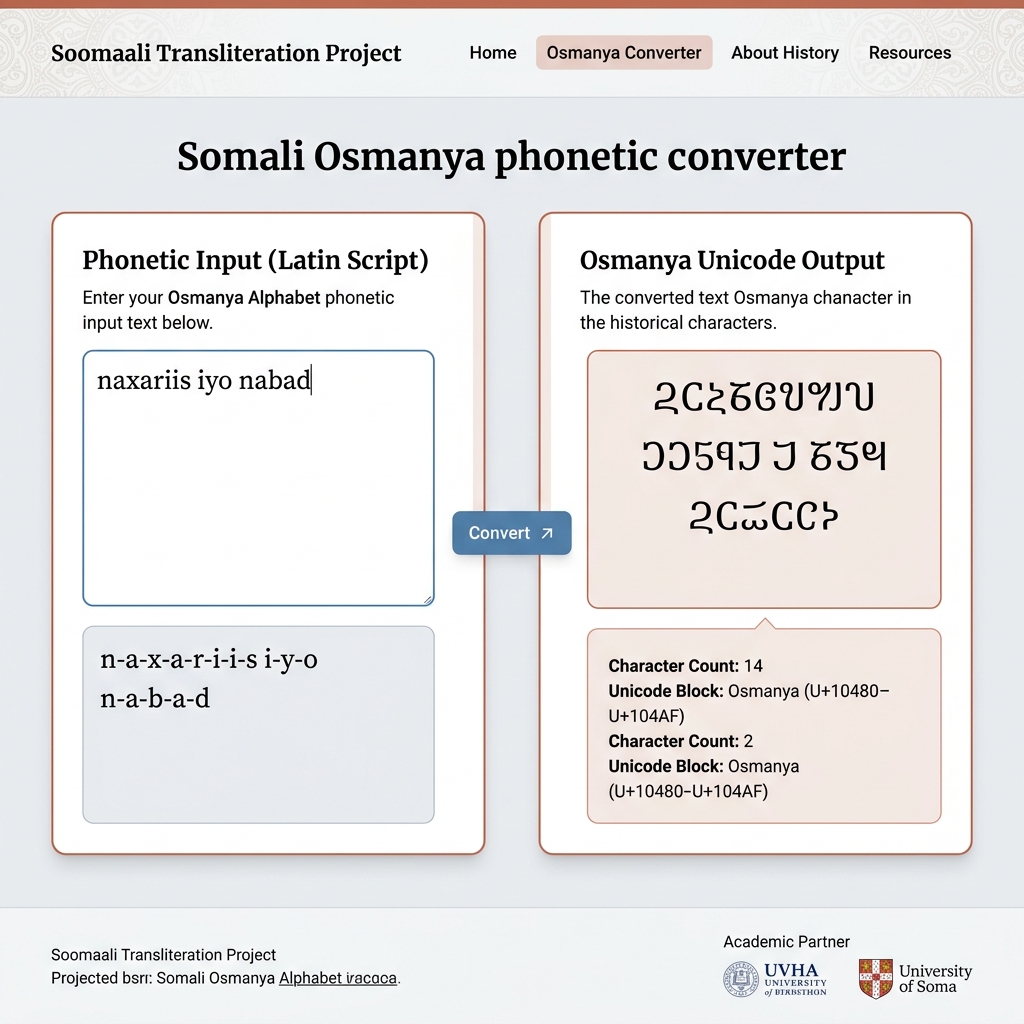
Instantly convert legacy Latin phonetic text into the historical Somali Osmanya script (𐒋𐒘𐒈𐒑𐒛𐒒𐒕𐒀). Supports the Unicode SMP (U+10480) for linguistics, historical research, and typography.
The Osmanya to Unicode Converter is an advanced, highly specialized linguistic engine designed to meticulously map standard Somali Latin phonetic characters directly into the indigenous Osmanya alphabet, also widely recognized by scholars and locals as Far Soomaali. Engineered specifically for professional linguists, East African historians, digital typographers, and cultural preservationists, this robust tool dynamically tokenizes legacy Latin inputs and flawlessly transliterates them into the official Unicode Supplementary Multilingual Plane (U+10480). By ensuring high-fidelity character matching, this platform guarantees that the rich heritage of the Somali language is accurately represented in modern digital environments without the need to rely on cumbersome external software or non-standard fonts.
Whether you are in the painstaking process of preserving and digitizing historical manuscripts from early 20th-century Somalia, designing cutting-edge educational materials for students in the Horn of Africa, or conducting deep academic research on the structural evolution of indigenous African writing systems, this offline-first converter provides secure, instantaneous, and mathematically precise transliteration. Because all tokenization and processing occur locally within your browser, you can be assured of complete data privacy while dealing with sensitive or culturally significant texts.
The Invention and History of Far Soomaali (Osmanya)
The story of the Osmanya alphabet is one of the most fascinating chapters in African linguistic history. Invented between the years 1920 and 1922 by Osman Yusuf Kenadid—the highly educated brother of the ruling Sultan of Hobyo—the script was born out of a profound cultural necessity. At that time, the Somali language, despite its incredibly rich oral tradition, possessed no standardized, universally accepted indigenous writing system. Religious scholars and political leaders primarily relied on an adapted version of the Arabic script, colloquially known as Wadaad's writing. However, because Arabic is fundamentally an abjad (a writing system where vowels are often implied rather than explicitly written), it drastically lacked the sufficient vowel representation required to accurately capture the highly complex, tonal, and vowel-heavy phonology of the Somali language.
Kenadid, recognizing this glaring deficiency, took it upon himself to engineer a completely new alphabet tailored specifically to the unique phonetic nuances of Somali. His creation, which would eventually bear his name as "Osmanya," gained immense and rapid popularity, particularly among the nationalistic youth. It sparked a massive, grassroots literacy movement across Somalia, becoming a symbol of intellectual sovereignty and anti-colonial resistance. By the mid-20th century and well into the early 1970s, Osmanya was viewed as a very strong contender to become the official state script, fiercely competing against the heavily entrenched Latin and Arabic alphabets.
Although the Somali government, under the leadership of Siad Barre, ultimately adopted the Latin script in 1972—a decision driven largely by economic pragmatism and typographical convenience, given that Latin typewriters and printing presses were cheap and abundant globally—Osmanya never truly faded into obscurity. Today, it remains a profound, enduring symbol of Somali cultural identity, linguistic independence, and historical ingenuity. You can explore more about similar digital preservation efforts by visiting our main Text Tools hub, where we actively work to archive and revive legacy scripts.
Linguistic Structure & Phonetic Mapping Complexities
From a purely linguistic standpoint, the structure of Osmanya is remarkably sophisticated. Unlike the Arabic script which it sought to replace, Osmanya is a true alphabet in every sense of the word. It is written from left to right, and crucially, every single vowel and consonant has a distinct, mandatory character that must be written out. This eliminates the phonetic ambiguity that plagued Wadaad's writing, allowing for precise pronunciation of written texts. Our advanced converter engine respects this structural integrity by utilizing a highly optimized, greedy tokenization algorithm to map standard, modern Somali Latin orthography to these unique, historical symbols.
For example, modern Somali Latin orthography makes heavy use of digraphs—pairs of letters that represent a single sound. The digraphs sh, dh, and kh represent single, distinct phonemes in the Somali language, not two separate sounds uttered sequentially. If a user types the letters sh into our tool, a naive, character-by-character converter would incorrectly output the Osmanya character for 's' immediately followed by the character for 'h'. Our intelligent engine, however, scans ahead. It recognizes the digraph as a singular phonetic entity and correctly outputs the singular Osmanya character 𐒉 (Sha). This greedy scanning methodology ensures that complex Somali phonetic clusters are perfectly preserved, offering a seamless typing experience that mirrors natural linguistic thought.
Technical Challenge: Rendering the Unicode SMP (U+10480)
From a software engineering and typography perspective, rendering Osmanya in a modern web browser presents a significant, highly technical challenge. Unlike common Latin or Cyrillic characters which reside in the Basic Multilingual Plane (BMP) of the Unicode standard, Osmanya is housed in the much rarer Supplementary Multilingual Plane (SMP). Specifically, it occupies the U+10480 to U+104AF code block, as defined by the official Unicode Consortium standards.
Because standard JavaScript strings are inherently encoded in UTF-16, characters located in the SMP cannot be represented by a single 16-bit integer. Instead, they require two 16-bit code units—a high surrogate and a low surrogate—working together in tandem (known as a surrogate pair) to render a single, coherent visual glyph. If a script inadvertently splits a surrogate pair, it results in data tearing, rendering the text as corrupted "tofu" boxes ().
Our custom-built conversion engine entirely mitigates this risk. It safely iterates over the raw string codepoints rather than relying on naive, index-based character lengths. By identifying and preserving surrogate pairs during the conversion process, we entirely prevent data tearing, even when reverse-transliterating complex, multi-byte historical Osmanya manuscripts back into modern Latin script. This guarantees 100% data integrity for academic researchers relying on our tool for archival preservation.
Cultural Impact and Modern Digital Revival
The digital age has brought about an unprecedented opportunity to revive endangered and historical scripts. For decades, the lack of widespread digital font support relegated Osmanya to physical manuscripts and dusty academic archives. However, with the standardization of the Unicode SMP and the proliferation of powerful web-based conversion tools, a new generation of Somalis in the diaspora are rediscovering their linguistic heritage.
By providing a frictionless, zero-install transliteration environment, this tool bridges the gap between modern technology and historical preservation. Users can seamlessly convert their daily communications, poetry, and academic essays into Far Soomaali, seamlessly copying and pasting the resulting Unicode into social media platforms, digital archives, and graphic design software. This digital revival is a testament to the resilience of the Somali culture and the ongoing global effort to ensure that the world's rich tapestry of writing systems is not lost to technological obsolescence.
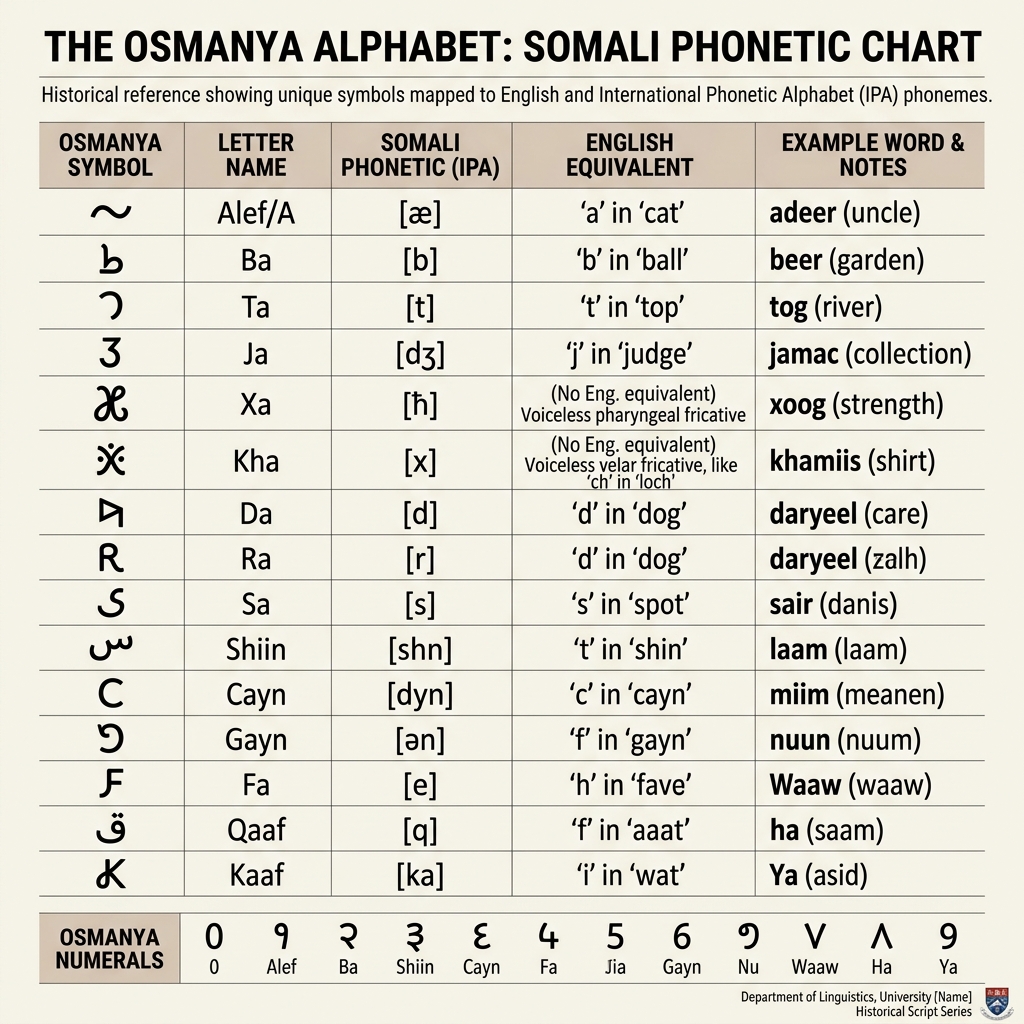
Comprehensive Osmanya Alphabet Mapping Table
Below is a highly detailed, quick-reference table demonstrating the precise mapping of modern Somali Latin orthography to their official Unicode Osmanya counterparts. This table serves as an invaluable resource for linguists verifying transliteration accuracy.
Latin Input (Orthography)
Osmanya Glyph
Phonetic Name (Somali)
Unicode Codepoint (SMP)
' (alef)
𐒀
Alef / Glottal Stop
U+10480
b
𐒁
Ba
U+10481
t
𐒂
Ta
U+10482
x
𐒄
Xa (Voiceless pharyngeal)
U+10484
kh
𐒅
Kha (Digraph)
U+10485
sh
𐒉
Sha (Digraph)
U+10489
dh
𐒊
Dha (Retroflex)
U+1048A
c
𐒋
Ca (Ayn)
U+1048B
Osmanya Typographic Reference Chart
Expert Insights & FAQs
Quick answers to common questions about this utility.
4 Frequently Asked Questions
What is the Osmanya alphabet?
The Osmanya alphabet (Far Soomaali) is an indigenous writing system for the Somali language, created between 1920 and 1922 by Osman Yusuf Kenadid. It was designed to perfectly capture the phonetic sounds of Somali, replacing the less-accurate Arabic script used at the time.
How do I type Somali digraphs like 'sh' and 'dh'?
Our converter features a greedy tokenization engine. Simply type 'sh' or 'dh' as you normally would in modern Somali Latin orthography. The engine will automatically combine the two keystrokes and output the correct, singular Osmanya character (e.g., 'sh' becomes 𐒉).
Why do Osmanya characters show up as empty squares?
Osmanya characters are located in the Supplementary Multilingual Plane (SMP) of Unicode (U+10480). Many default operating system fonts do not include glyphs for these rare historical blocks. You must install a fallback font (such as a specialized African Unicode font or Noto Sans Osmanya) to view them natively outside of this tool.
Are there capital and lowercase letters in Osmanya?
No. Unlike the Latin alphabet, Osmanya does not differentiate between uppercase and lowercase letters. The characters maintain a uniform size and shape regardless of their position in a sentence.