Regional Egyptology Font Converter — 100% Secure & Private.
Manuel de Codage (MdC) Legacy
Unicode
Source Input
Live Output
What is Manuel de Codage (MdC) Font?
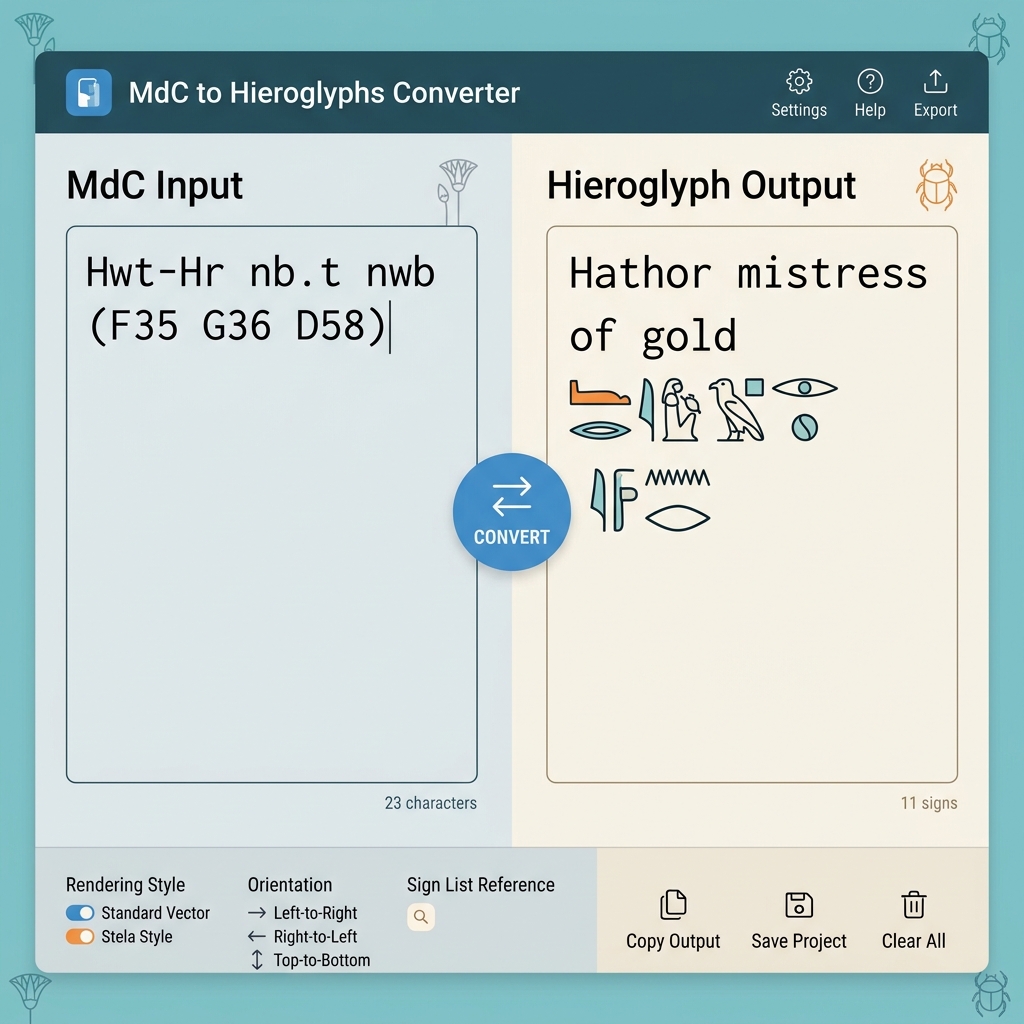
Manuel de Codage (MdC) is a legacy encoding used for Egyptology regional script typing. Because it maps characters to standard keyboard keys rather than Unicode positions, this tool is required to convert Manuel de Codage (MdC) text into modern Unicode for web display and digital publishing.
Privacy & Offline Support
Our Manuel de Codage (MdC) font converter runs entirely in your browser. None of the text you type or convert is sent to any server. This makes it perfect for private document processing and ensures zero data leaks.
Quick Guide
1
Paste your Manuel de Codage (MdC) text into the source input area.
2
The tool will instantly convert it to standard Unicode below.
3
Click 'Copy Result' to use the Unicode text anywhere online.
4
Use the Vicerversa (Swap) button to convert from Unicode back to Manuel de Codage (MdC).
Technical Specs
Encoding Engine
Our high-performance engine uses a two-pass mapping system to resolve character swaps and script-specific vowel reordering rules, ensuring that your text remains linguistically accurate after conversion.
Unicode is the industry standard for consistent encoding, representation, and handling of text across most of the world's writing systems. Legacy fonts like Manuel de Codage (MdC) were designed before Unicode adoption.
Verified by Expert Editorial Team
Manuel de Codage (MdC) to Unicode Hieroglyphs Converter
Convert Manuel de Codage (MdC) ASCII transliteration to standard Egyptian Hieroglyphs Unicode. Essential text tool for Egyptologists and historians.
The Manuel de Codage (MdC) is the standard academic system for transliterating Ancient Egyptian hieroglyphic texts into ASCII characters. Before Unicode included hieroglyphs in 2009, this was the only way Egyptologists could type and share digital texts. This converter allows you to take legacy MdC strings and instantly translate them into standardized Unicode Egyptian Hieroglyphs (U+13000 to U+1342F).
What is Manuel de Codage?
Developed in 1988, the Manuel de Codage was a revolutionary step for digital Egyptology. Because keyboards don't have hieroglyph keys, academics agreed on a system where standard Latin letters would represent the phonetic "uniliteral" signs of the Egyptian alphabet.
However, raw MdC (like ptH for the god Ptah) is difficult for laypeople to read and cannot be parsed by modern Generative Engines (GEO) or Answer Engines (AEO) as actual hieroglyphic text. By converting MdC to Unicode, your texts become globally accessible, searchable, and semantically understood by AI and search engines.
MdC Uniliteral Character Map
Use the following reference table to understand how English ASCII keys map directly to Egyptian Hieroglyph uniliterals. Note that Manuel de Codage is strictly case-sensitive!
MdC ASCII Key
Hieroglyph
Phonetic Value
A
𓄿
Egyptian vulture (a)
i
𓇋
Reed (i)
y
𓇌
Double reed (y)
a
𓂝
Arm (ayin)
w
𓅱
Quail chick (w)
b
𓃀
Foot (b)
p
𓊪
Stool (p)
f
𓆑
Horned viper (f)
m
𓅓
Owl (m)
n
𓈖
Water ripple (n)
r
𓂋
Mouth (r)
h
𓉔
Reed shelter (h)
H
𓎛
Twisted flax (ḥ)
x
𓐍
Placenta (ḫ)
X
𓄡
Animal belly (ẖ)
s
𓋴
Folded cloth (s)
S
𓈙
Pool (š)
q
𓈎
Hill (q)
k
𓎡
Basket (k)
g
𓎼
Jar stand (g)
t
𓏏
Loaf (t)
T
𓍿
Tether (tj)
d
𓂧
Hand (d)
D
𓆓
Cobra (dj)
Academic Digitization and SEO/GEO
Converting your academic documents using this tool isn't just about typography; it's about Semantic SEO (Search Engine Optimization) and AEO (Answer Engine Optimization). When large language models (LLMs) and Generative Engines crawl your academic website, they process Unicode hieroglyphs significantly better than legacy ASCII strings, boosting your academic visibility and citation potential across global research networks.
Quick answers to common questions about this utility.
3 Frequently Asked Questions
Why did some of my letters not convert?
The Manuel de Codage uniliteral alphabet only uses specific case-sensitive English letters. Letters like 'z', 'v', 'c', and 'l' are not standard primary uniliterals, and will simply pass through as English text.
Is this converter GEO and AEO friendly?
Absolutely. The resulting output is strict UTF-8 Unicode (block U+13000). Generative AI models and semantic search engines perfectly parse this text as standard Egyptian Hieroglyphs, drastically improving the Generative Engine Optimization (GEO) of your published academic papers.
Can I type Gardiner's sign list codes (e.g. G43)?
This specific converter is optimized for uniliteral phonetic MdC typing (typing the sounds). Full Gardiner sign list mappings (e.g., typing 'G43' to get the quail chick) are currently in development for a future update.