Regional Indology Font Converter — 100% Secure & Private.
Harvard-Kyoto / Velthuis Legacy
Unicode
Source Input
Live Output
What is Harvard-Kyoto / Velthuis Font?
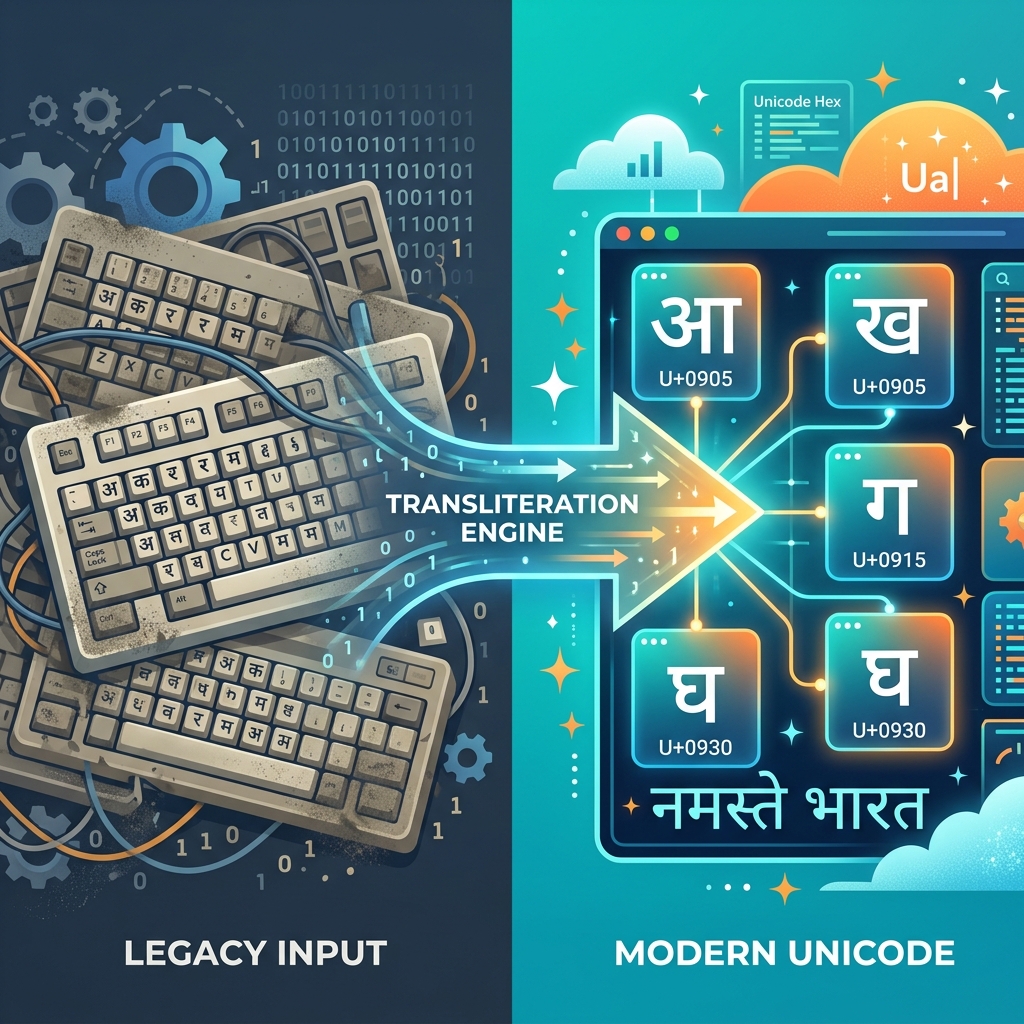
Harvard-Kyoto / Velthuis is a legacy encoding used for Indology regional script typing. Because it maps characters to standard keyboard keys rather than Unicode positions, this tool is required to convert Harvard-Kyoto / Velthuis text into modern Unicode for web display and digital publishing.
Privacy & Offline Support
Our Harvard-Kyoto / Velthuis font converter runs entirely in your browser. None of the text you type or convert is sent to any server. This makes it perfect for private document processing and ensures zero data leaks.
Quick Guide
1
Paste your Harvard-Kyoto / Velthuis text into the source input area.
2
The tool will instantly convert it to standard Unicode below.
3
Click 'Copy Result' to use the Unicode text anywhere online.
4
Use the Vicerversa (Swap) button to convert from Unicode back to Harvard-Kyoto / Velthuis.
Technical Specs
Encoding Engine
Our high-performance engine uses a two-pass mapping system to resolve character swaps and script-specific vowel reordering rules, ensuring that your text remains linguistically accurate after conversion.
Unicode is the industry standard for consistent encoding, representation, and handling of text across most of the world's writing systems. Legacy fonts like Harvard-Kyoto / Velthuis were designed before Unicode adoption.
Verified by Expert Editorial Team
Harvard-Kyoto / Velthuis to Unicode Converter
Convert Harvard-Kyoto and Velthuis ASCII transliteration to standard Devanagari Unicode. Perfect for Indology researchers and Sanskrit academics.
Before Unicode supported complex Indic scripts, scholars and academics in the field of Indology needed a way to type Sanskrit and Vedic texts using standard Western ASCII keyboards. This led to the creation of transliteration schemes like Harvard-Kyoto and Velthuis. These systems map the phonetic sounds of Devanagari directly to English letters (e.g., typing "aa" or "A" for "आ", "R" for "ऋ"). The Harvard-Kyoto to Unicode Converter instantly translates these academic ASCII representations into genuine, permanent Devanagari Unicode.
Understanding Harvard-Kyoto
Harvard-Kyoto is a strictly 1-to-1 ASCII transliteration convention. Unlike IAST (which uses diacritics like 'ā' or 'ṣ' that are hard to type), Harvard-Kyoto relies entirely on standard keyboard letters, using capital letters for long vowels and retroflex consonants (e.g., 'T' for 'ट्', 'S' for 'ष्').
While this makes typing incredibly fast for academics, the raw text is unreadable to anyone outside the field and looks like English gibberish to standard web browsers. Modern Unicode solves this by providing universal encoding for the actual Devanagari glyphs.
How the Parsing Engine Works
Converting Harvard-Kyoto is more complex than a simple character swap because of Sanskrit's inherent vowels and complex conjuncts (ligatures).
When you input "kSa", the engine doesn't just output three separate letters. It parses the phonetic grouping, recognizes the consonant cluster, and generates the exact Unicode sequence (क् + ष् + अ = क्ष) required to render the complex typographic ligature perfectly on any modern device.
How to Convert Your Texts
Open your academic document or raw text file containing the ASCII transliteration. Copy the text and paste it into the converter's input box.
The system instantly processes the syntax and outputs flawless Devanagari Unicode (संस्कृतम्). You can safely copy this text and paste it directly into academic papers, websites, or messaging apps. The text will render beautifully across all operating systems.
Preserving Academic Archives
Massive digital archives, early email chains, and academic datasets from the 1990s and 2000s are locked in ASCII transliteration.
By converting these archives to standard Devanagari Unicode, researchers can make these texts searchable in native scripts and accessible to a much wider audience, bridging the gap between Western academia and native readers.
Expert Insights & FAQs
Quick answers to common questions about this utility.
3 Frequently Asked Questions
Does this support IAST or ITRANS?
This specific converter is optimized for Harvard-Kyoto and Velthuis syntax. We are continually adding support for other academic transliteration schemes.
Why did a consonant cluster fail to form a ligature?
Make sure you are strictly following the Harvard-Kyoto capitalization rules. For example, 'S' (capital) is 'ष्', while 's' (lowercase) is 'स्'. Incorrect capitalization will result in incorrect phonetic mapping.
Can I convert Devanagari back to Harvard-Kyoto?
Yes, the tool is bidirectional. You can toggle the converter to translate native Devanagari text back into Harvard-Kyoto ASCII for use in specialized linguistic software.