Regional USA (Utah/LDS) Font Converter — 100% Secure & Private.
Deseret Alphabet Legacy
Unicode
Source Input
Live Output
What is Deseret Alphabet Font?
Deseret Alphabet is a legacy encoding used for USA (Utah/LDS) regional script typing. Because it maps characters to standard keyboard keys rather than Unicode positions, this tool is required to convert Deseret Alphabet text into modern Unicode for web display and digital publishing.
Privacy & Offline Support
Our Deseret Alphabet font converter runs entirely in your browser. None of the text you type or convert is sent to any server. This makes it perfect for private document processing and ensures zero data leaks.
Quick Guide
1
Paste your Deseret Alphabet text into the source input area.
2
The tool will instantly convert it to standard Unicode below.
3
Click 'Copy Result' to use the Unicode text anywhere online.
4
Use the Vicerversa (Swap) button to convert from Unicode back to Deseret Alphabet.
Technical Specs
Encoding Engine
Our high-performance engine uses a two-pass mapping system to resolve character swaps and script-specific vowel reordering rules, ensuring that your text remains linguistically accurate after conversion.
Unicode is the industry standard for consistent encoding, representation, and handling of text across most of the world's writing systems. Legacy fonts like Deseret Alphabet were designed before Unicode adoption.
Verified by Expert Editorial Team
Deseret Alphabet to Unicode Phonetic Converter
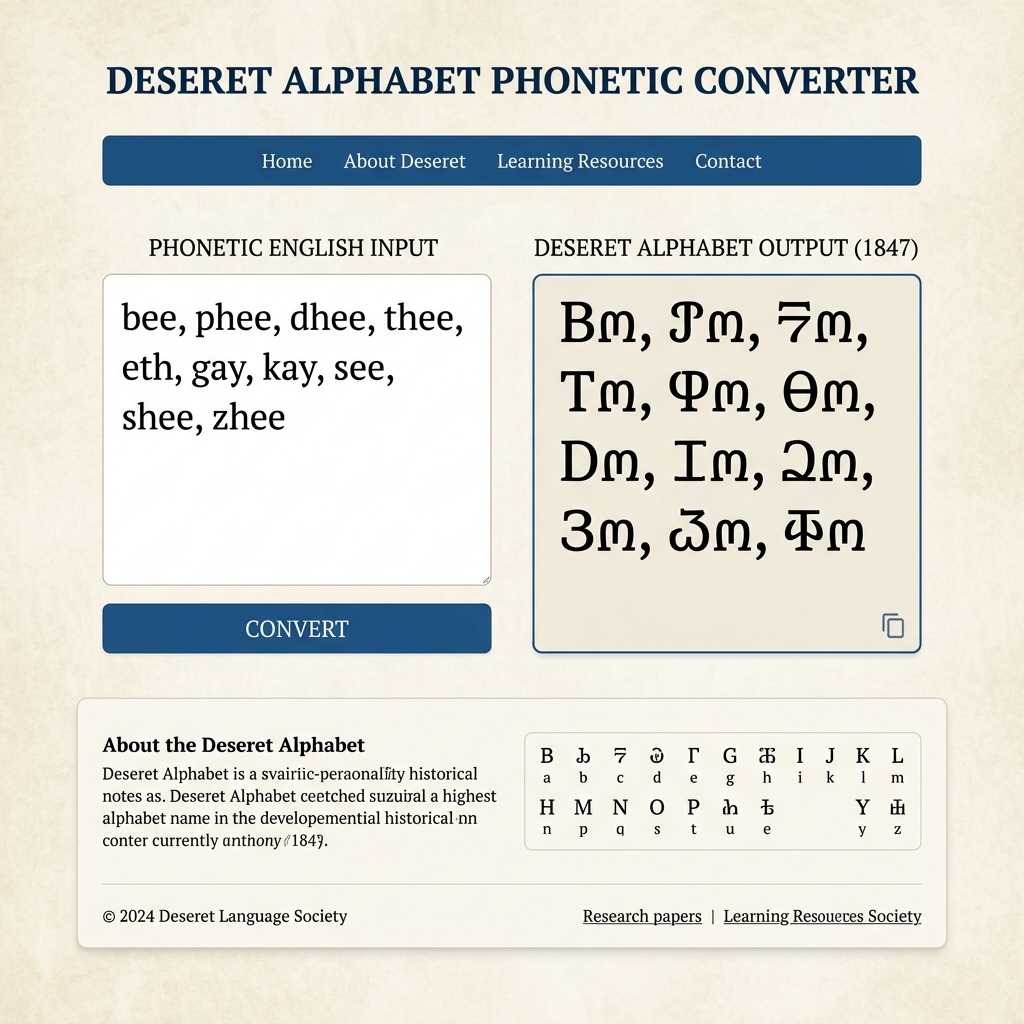
Translate modern English phonetic labels directly into the historical 1847 Mormon Deseret Alphabet. Instantly generate SMP Unicode characters (U+10400) for historical research, typography, and cryptography.
The Deseret Alphabet to Unicode Converter is a specialized historical typography tool designed to bring the 19th-century spelling reform experiment of the early LDS (Mormon) Church into the modern digital age. By typing standard English phonetic labels (such as bee, phee, thee, ah, aw), this tool tokenizes your input and outputs true Deseret Alphabet characters located in the Unicode Supplementary Multilingual Plane (U+10400).
Whether you are a historian transcribing early Utah pioneer journals, a linguist studying English spelling reform movements, or a typographer working on historical fonts, this converter provides a secure, offline, and highly accurate bridge between Latin phonemes and Deseret Unicode.
The Fascinating History of the Deseret Alphabet
In 1847, Brigham Young and the early members of the Church of Jesus Christ of Latter-day Saints settled in the Salt Lake Valley. As European immigrants poured into the territory, Young realized that the chaotic, non-phonetic spelling of the English language was a massive barrier to education and assimilation.
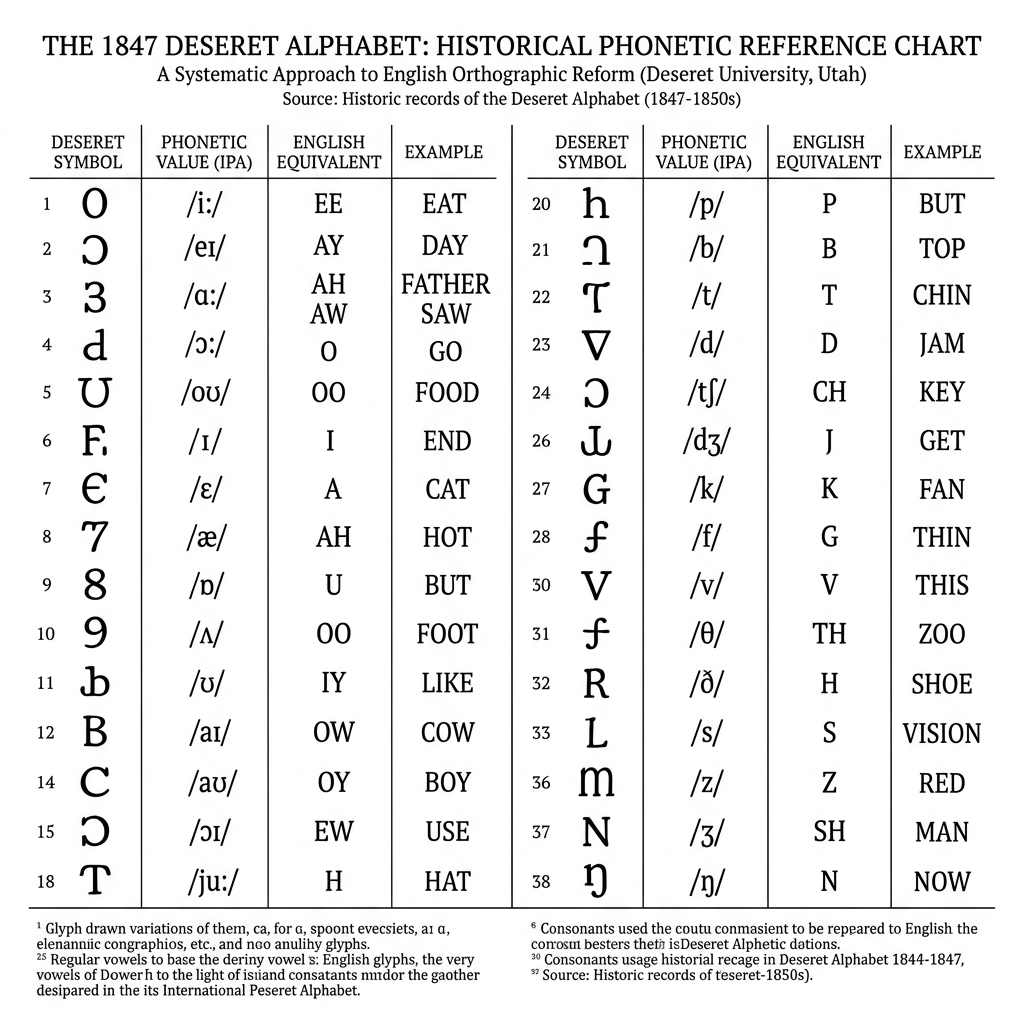
To solve this, the Board of Regents of the University of Deseret (now the University of Utah) was commissioned to create a completely new phonetic alphabet for the English language. Prominent members, including George D. Watt (who was trained in Pitman shorthand), developed a 38-character alphabet where one symbol strictly equaled one sound.
Despite heavy promotion in the 1850s and 1860s—including the printing of primers, a phonetic dictionary, and the Book of Mormon—the alphabet ultimately failed to gain widespread adoption. It was expensive to cast the new typefaces, difficult to read quickly due to the lack of ascenders and descenders (every letter looked uniformly round), and it isolated the Utah territory from the rest of the English-speaking world.
How the Phonetic Structure Works
The Deseret Alphabet is entirely phonetic. It completely discards standard English spelling rules. The word "phone" is not spelled with a 'p' and an 'h'; it is spelled with the character for f (ef), the character for o (o), and the character for n (en).
The 38-character alphabet is divided into:
Long Vowels (6): Sounds like ee (as in see), ah (as in father).
Short Vowels (6): Sounds like ih (as in pit), uh (as in cup).
Double Vowels / Diphthongs (4): Sounds like ay (as in pay), ow (as in cow).
Consonants (22): Sounds like phee (f), thee (th), esh (sh).
Technical Challenge: The Unicode SMP (U+10400)
Unlike standard Latin or even Cyrillic characters, the Deseret Alphabet is not located in the Basic Multilingual Plane (BMP) of Unicode. It was added to the standard in 2001 and placed in the Supplementary Multilingual Plane (SMP), specifically in the U+10400 to U+1044F block.
In JavaScript and many modern programming languages, strings are encoded in UTF-16. Characters in the BMP take up exactly one 16-bit code unit. However, characters in the SMP require surrogate pairs — two 16-bit code units joined together to represent a single character on the screen.
If you attempt to reverse-convert a Deseret string using standard array splits or simple string iteration, you will slice the surrogate pair in half, destroying the character and returning a corrupted symbol.
How the Tokenization Engine Works
Our converter is specifically engineered to handle the complexities of the SMP and historical phonetic mapping.
Latin to Deseret: The engine expects space-delimited phoneme labels (e.g., bee aw yoo for 'boy'). It tokenizes the string by whitespace and maps each distinct English phoneme label directly to its Deseret SMP equivalent.
Deseret to Latin: The reverse engine uses String.prototype.codePointAt() instead of standard character indexing. It safely steps over both the high and low surrogate pairs of the UTF-16 string, preventing data tearing and accurately returning the English phoneme labels.
Deseret Alphabet Mapping Table
Below is a quick reference table showing the mapping of common English phonetic labels to their Unicode Deseret characters.
Quick answers to common questions about this utility.
4 Frequently Asked Questions
What is the Deseret Alphabet?
The Deseret Alphabet is a 38-character phonetic alphabet developed in 1847 by the Board of Regents of the University of Deseret (now the University of Utah). It was heavily promoted by Brigham Young and early LDS Church leaders to simplify the chaotic spelling of the English language for European immigrants moving to the Utah territory. It was abandoned shortly after Young's death.
How do I type words into this converter?
Because the Deseret alphabet is entirely phonetic, you do not type standard English spelling. You type space-delimited phoneme labels. For example, to type the word 'phone', you would type 'phee o en', representing the 'f' sound, 'o' sound, and 'n' sound. The converter maps those labels directly to the corresponding Deseret characters.
Why do Deseret characters show up as empty squares on my phone?
Deseret characters are located in the Supplementary Multilingual Plane (SMP) of Unicode (U+10400). Because it is a highly obscure historical script, many default operating system fonts (especially on older Android and iOS devices) do not include glyphs for it. You may need to install a fallback font that covers the SMP to view them natively outside of this tool.
Are there capital and lowercase letters in Deseret?
Yes, the Deseret alphabet includes both uppercase and lowercase letters. However, they are visually identical in shape; the only difference is their size relative to the baseline. Our converter primarily maps to the uppercase variants for maximum legibility.