Regional Indonesia (Sulawesi) Font Converter — 100% Secure & Private.
Buginese / Lontara Legacy
Unicode
Source Input
Live Output
What is Buginese / Lontara Font?
Buginese / Lontara is a legacy encoding used for Indonesia (Sulawesi) regional script typing. Because it maps characters to standard keyboard keys rather than Unicode positions, this tool is required to convert Buginese / Lontara text into modern Unicode for web display and digital publishing.
Privacy & Offline Support
Our Buginese / Lontara font converter runs entirely in your browser. None of the text you type or convert is sent to any server. This makes it perfect for private document processing and ensures zero data leaks.
Quick Guide
1
Paste your Buginese / Lontara text into the source input area.
2
The tool will instantly convert it to standard Unicode below.
3
Click 'Copy Result' to use the Unicode text anywhere online.
4
Use the Vicerversa (Swap) button to convert from Unicode back to Buginese / Lontara.
Technical Specs
Encoding Engine
Our high-performance engine uses a two-pass mapping system to resolve character swaps and script-specific vowel reordering rules, ensuring that your text remains linguistically accurate after conversion.
Unicode is the industry standard for consistent encoding, representation, and handling of text across most of the world's writing systems. Legacy fonts like Buginese / Lontara were designed before Unicode adoption.
Verified by Expert Editorial Team
Buginese/Lontara Script to Unicode Converter
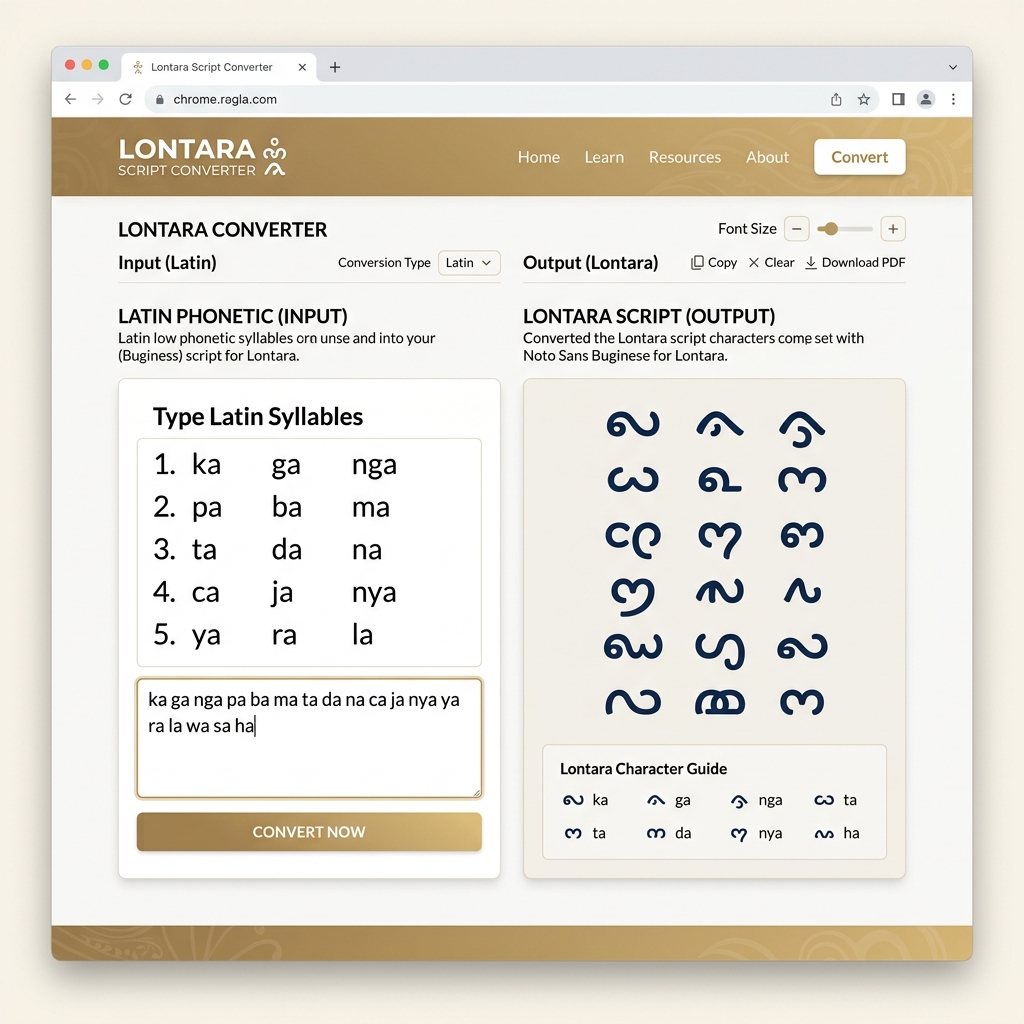
Convert Latin phonetic syllables directly into the beautiful Buginese (Lontara) Unicode script. An offline, sophisticated syllabary tokenizer for Indonesian linguistic preservation.
The Buginese/Lontara to Unicode Converter is a specialized cultural and linguistic utility designed to bridge modern Latin typography with the traditional writing system of the Bugis, Makassarese, and Mandar peoples of Sulawesi, Indonesia. By typing standard Latin phonetic syllables (such as ka, ga, nga), this tool automatically tokenizes and transcribes your text into the elegant, sweeping curves of the true Buginese Unicode script (U+1A00).
The Lontara script is a Brahmic abugida, historically written on palm leaves (lontar), which explains its lack of straight lines and sharp angles. Because it is a syllabary rather than an alphabet, converting it requires complex multi-character parsing.
The History and Structure of the Lontara Script
The Lontara script (also known as Bugis script) is traditionally used to write several languages in South Sulawesi, Indonesia. The term "Lontara" refers to the palm leaves on which traditional manuscripts were written. The physical properties of the palm leaf dictated the shape of the letters: straight, sharp lines would tear the leaf grain, so the script evolved to be composed almost entirely of curves and circles.
Lontara is an abugida (or alphasyllabary). Unlike the English alphabet where consonants and vowels are separate letters (like K + A = KA), an abugida treats the consonant-vowel pair as a single unit. In Lontara, the base character for "K" inherently carries the vowel "A", making it "KA" (ᨀ). To change the vowel to an "I" ("KI"), a diacritic mark (a dot) is added above the character.
Why Lontara Conversion is Complex
If you try to convert Latin text to Lontara with a simple 1-to-1 search-and-replace, the text will be destroyed. This is because a single Lontara character often represents two, three, or even four Latin letters.
For example, consider the Latin string ngka. In English, that is four distinct letters. But in Lontara, ngka is a single prenasalized consonant character: ᨃ. If a poorly designed converter processed this letter-by-letter, it would output the character for "N", then "G", then "K", resulting in absolute gibberish to a native reader.
How the Syllabary Tokenization Engine Works
To accurately transcribe Latin phonetics into Lontara Unicode, our engine employs a Greedy Longest-Match Tokenizer. When you paste Latin text, the engine does not look at individual letters. Instead, it scans the text in chunks:
3-Character Pass: First, it looks at a block of 3 or 4 letters. If it sees ngk, nyc, or nra, it instantly maps that block to the correct single prenasalized Lontara character.
2-Character Pass: If no 3-letter match is found, it shrinks its view to 2 letters, looking for standard digraphs like ng, ny, ka, or pa.
1-Character Pass: If no digraph is found, it falls back to single-letter evaluation.
This greedy matching guarantees that complex consonant clusters are safely grouped and converted into their correct syllabic representations.
Lontara Syllable Mapping Table
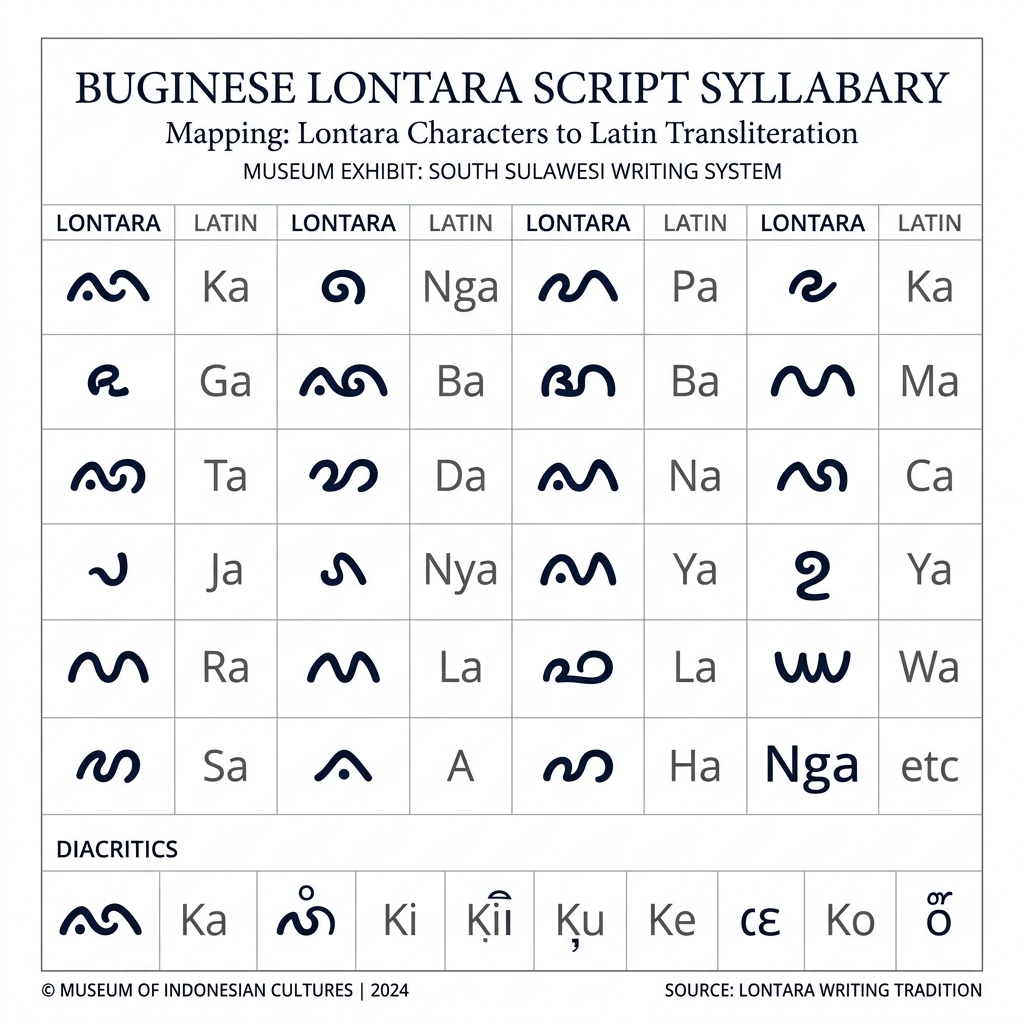
Below is a reference table showing how various Latin phonetic syllables map into the Buginese Unicode Block (U+1A00 to U+1A1F).
Latin Syllable
Buginese Character
Unicode Codepoint
Type
ka
ᨀ
U+1A00
Consonant
ga
ᨁ
U+1A01
Consonant
nga
ᨂ
U+1A02
Consonant
ngka
ᨃ
U+1A03
Prenasalized Consonant
pa
ᨄ
U+1A04
Consonant
ba
ᨅ
U+1A05
Consonant
ma
ᨆ
U+1A06
Consonant
mpa
ᨇ
U+1A07
Prenasalized Consonant
ta
ᨈ
U+1A08
Consonant
Buginese Lontara Reference Chart
Cultural Preservation and Digital Use Cases
With the rise of smartphones and digital messaging, many younger speakers of Buginese and Makassarese communicate entirely using the Latin alphabet. Tools like this converter are critical for cultural preservation:
Digital Transcription: Allowing native speakers to easily type in Latin and instantly generate authentic Lontara script for social media, digital publishing, and educational materials.
Linguistic Research: Anthropologists and linguists digitizing historical La Galigo manuscripts (the epic creation myth of the Bugis) rely on phonetic-to-script conversion pipelines to create searchable Unicode databases.
Typographic Design: Graphic designers needing to incorporate traditional Indonesian scripts into posters, branding, or UI designs without having to hunt down a specialized physical keyboard layout.
Wikipedia: Lontara Script — Comprehensive overview of the script's history, palm leaf manuscripts, and usage in South Sulawesi.
Expert Insights & FAQs
Quick answers to common questions about this utility.
4 Frequently Asked Questions
What is the Lontara or Buginese script?
The Lontara script is a traditional Brahmic writing system used by the Bugis, Makassarese, and Mandar peoples of South Sulawesi, Indonesia. It is famous for its beautiful, curved, circular aesthetic. Historically, it was written on palm leaves (called 'lontar').
Why do multiple Latin letters turn into one Buginese character?
Lontara is an 'abugida' (a syllabary), not an alphabet. In English, 'k' and 'a' are separate letters. In Lontara, 'ka' is a single character. Furthermore, the script has special characters for prenasalized consonant clusters. Therefore, typing the four Latin letters 'ngka' results in exactly one Lontara character.
Does this converter support the Makassarese and Mandar variations?
Yes. The Buginese Unicode block (U+1A00) is unified and used to digitally represent the Lontara script across all the regional languages of South Sulawesi, including Buginese, Makassarese, and Mandar.
Is this converter safe for sensitive or unpublished research data?
Yes, the transliteration engine runs entirely locally in your web browser using JavaScript. Nothing you type is sent to a server, making it perfectly safe for unpublished linguistic research or private communications.